

02.04.2026
A Look in the Rear-view Mirror: My Own Journey with Ahola from 1955 to the Present 1980s
The Next Career Step in the Family Business
Introduction:
I will continue the same way by presenting my memories and thoughts from three perspectives:
- Our company and my own experiences
- The transport industry
- Society
But before we start on the 80s, here are some events that took place in the 70s that I forgot to include in the article.
I become a partner
My father had already talked to me for some time about becoming a partner and co-owner in our company. My father operated the company as a sole trader until 1977. At that time, it became necessary to change accounting firms. We enlisted the Rolf Finne Kb accounting firm. When the decision was made to incorporate the business as a limited partnership, my father suggested that I should become a partner in the company. By that time, my father had quite a bit earlier informed me that his intuition told him that he would not live long. Naturally, I did not take him seriously; he was barely 45 years old. Perhaps he had simply realised that I was passionate about running and developing the business.
Of course, I found that very motivating, even though I had always taken it for granted that I would continue to run the business.
My father, himself having grown up without a father, was keen to encourage and support me.
He wanted me to feel how much confidence he had in me. That did wonders for my self-esteem.
A Terrible Accident – a Close Call!
Another event that I forgot to mention in my last post was what happened in the summer of 1978. Tiina and I got married in June; the following incident took place in August. I had loaded some fish at Vasklot harbour in Vaasa, and I was about to drive home to Kokkola. When I got to the Maxmo intersection, I looked in the mirror to see a large amount of smoke emanating from the trailer’s rearmost axle. I stopped at a bus stop to check on the situation, which had escalated into a fire in the right wheel. I went to a nearby farm, where I got water to put of the fire.
As I crawled under the carriage to put out the fire in the brake system, the tyre exploded right against my head. My head was barely a metre away from the exploding tyre. The bang was incredible and it resulted in some extremely hot rubber burning into my forehead close to my eyes. I image that the protective hand of an angel was the only thing that saved my life. Fortunately for me, a woman approached immediately to help me and tried to protect my eyes. It was not so easy to do, as my head was incredibly swollen.
I was in excruciating pain as I waited for the ambulance to arrive. The next thing I remember was waking up in the hospital. It was an anxious time in the hospital. When Tiina came to visit, even she had a tough time recognising me as my head was so extremely swollen. As I said, I was anxious as my face was all wrapped tight and covered in burnt rubber. For the first six days, it was not certain that I would retain my sight. However, by the second week in the hospital, I began to open my eyes and was delighted to find out that I would continue to be able to see. As a constant reminder of the accident, I got quite a black “tattoo” on my forehead, which after many years now has nearly completely disappeared. What remain are some encapsulated metal particles in my right eye and a strong tinnitus. However, I cannot be bothered to listen to that anymore. I simply thank God for having saved me. My life may have become quite different had I lost my sight. It is likely a miracle that I survived the accident at all.
So begins the 1980s – My Father’s Passing and Challenging Situations
Before long, it became clear that my father’s intuitions and feelings about his health began to materials, including through various pains. The 1980 – 1981 period saw a number of visits to the doctor. My father was not so keen to contact the doctor and find out the reason for his pain. It was likely my mother who prodded and urged my father to get in touch with the doctor and ascertain the reason for his symptoms. In July 1981, an MRI scan showed that the situation was serious. My father likely had a sense of how things would turn out. He therefore urged me to buy a part of the company, which I did. You should always obey your parents, right?
He had cancer in one lung, so an emergency trip to Oulu University Hospital was made for an immediate operation. After the operation, we got the sad news. The cancer was very aggressive and there was no serious hope of recovery. My Dad passed away on 14 March, 7 months after his surgery at the age of 51. This was a great tragedy for all of us. My mother was only 49 years old and seven of our siblings still lived at home.
Overall Responsibility
These were also challenging times economically, as we were at a strategic turning point regarding our future direction.
At that moment, our business consisted of six trucks, two tankers and four freight trucks.
Over the previous 15 years, our service facilities were housed in an old, disused cowshed near the main farm in Närvilä.
Brothers Come in as Partners
In 1981, we bought a plot of land here at the Indola industrial area in Kokkola to build a new service hall for our business operation. Construction started the same year, and the building project lasted until the summer of 1982. As my father passed away on 14 March 1982, he never got to see this new building. We were living in a time of deep sorrow and loss back then. After my father’s death, Lars and Nils joined as partners in the company. Rolf was still a minor and therefore could not become a partner at that time.

One of our tankers 1986
Next Steps
When I assumed overall responsibility for management, there were plenty of matters to address immediately. Among other things, we had to contend with some rather large debts, some of which were past due. Working with our accountant, Rolf Finne, we ran some profitability simulations and arranged payment plans with various creditors. However, despite the plans, the situation became so severe that I found myself in contact with a bailiff. Even when in such a tough predicament, the situation never felt hopeless. I felt strongly that we would succeed. I felt that I was supported by the prayers of many people. Together with my brothers, we worked hard and kept a positive attitude.
The First Office Employee
It was then that my wife, Tiina, began working at the company as our first office employee. Tiina is meticulous and a logical thinker; that was why she was able to present the facts about income and expenses in a simple way. Her task was to crunch the numbers and present them in manageable and understandable terms. This provided a basis for simulating future plans in both the short and long term.
Her task was to take care of the ledger, but the accounting was still done by Rolf Finne’s accounting firm. Tiina was also given the responsibility to take care of both export and import customs clearance. She had no experience in this field, but thanks to her precise manner of working, she did an excellent job.
Later in the 1980s, I found an excellent tool for business simulation. I ran three-year simulations, and what convinced me of the model’s reliability was that the actual results were consistently better than the forecasts. Tiina also has an artistic flair, so she visualised the internal and external communication at an early stage. I’ll come back to this in my next post about the 90s.
New customer segments and customers
In 1983, there was an opportunity to grow the business by buying the transport operations from the Kokkomentti element factory. The managing director at Kokkomentti was known to our family, which probably helped in reaching a mutually beneficial solution. Kokkomentti wanted to focus on the manufacture of concrete elements, while we focused on transport. The construction industry was in a strong growth phase during the 80s, which suited us well. This trend continued throughout the 90s resulting in a good level of growth for us. Initially, this concerned projects in Finland; later, it expanded to include international projects in both Norway and Sweden.
This also gave us an opportunity to start with specialised transportation, as similar equipment was needed.

Concrete element transports to Sweden with our ingenious innovation of removable and collapsible element trestles, which enabled return loads. This was unique at the time.

Cisterns for Oravainen factories

Hans and Jonas on their way to Harstad in Northern Norway 1986

Our first telescoping trailer 1984
An Interesting Turnaround for Transport in the Fur Industry
Our company had already been more or less involved in the transportation of what was then the lucrative fur industry for over ten years. The early 80s were a golden age for the fur industry. The industry was heavily centrally controlled by Ostrobottnia Päls, which was owned by all the feed kitchens, numbering around thirty in total. In little Nykarleby alone there were four different feed kitchens at that time: Farm-Frys, Nyko-Frys, Monäs Frys and Vexala Frys. For decades, the fur industry has been a very large and significant industry in Ostrobothnia and especially in Swedish Ostrobothnia. This industry employed the transport industry considerably during the heyday of the fur industry.
A large part of the business concerned fish by-product imports from northern Norway, but also from Sweden, Denmark and even at times from Murmansk in the Soviet Union. In addition to Ostrobottnia Päls, there was another import company: Oy Iskalotten Ab. As the need for raw materials varied during the year; a raw material buffer and stock was needed to even out and buy up all the fish by-product that was available all year round. The hometown of Iskalotte was Karigasniemi on the border with Norway, where the company had a cold store for storage when demand was lower. To ensure logistics and transport, Ostrobottnia Päls and Iskalotten had formed a jointly owned freight forwarding and logistics company that conducted the transportation. Due to the large import volumes, a near‑monopoly situation developed in transportation in Northern Norway, which may have led to unreasonably high transport costs. Our role was quite insignificant during the 70 –80s right up to the year 1986. We had some of our own customers such as Finnjak and a few individual feed manufacturers. We also handled occasional ‘spot’ jobs for smaller feed kitchens, and during some high-season periods we participated in the ‘fish rally’ from Murmansk.

A small innovation with the special wheelbase that allowed for more payload in Norway.

A new sailboat for His Royal Highness Crown Prince Harald of Norway

”Real truckers”
A New Opportunity
Back in 1986, I spoke quite often with various leaders of the feed kitchens and, among others, Stig Ventjärvi, who was CEO of Oy Jääkala Ab. He often complained that transport costs were too high from northern Norway. I also knew Iskalotten’s CEO Jan Vidberg, and he had the same message, because much of the value of the goods consisted of shipping costs. I suggested that Ahola would be willing to submit a proposal to handle Iskalotten’s entire transport needs. This was also made possible due to an ownership restructuring. This paved the way for Iskalotten to open the transport services to competition, which they proceeded to do. The bid for the transports was between Ahola and the competitor, whose bid was significantly higher.
To ensure that Jan Vidberg was certain of his position, I asked him to hold another discussion with the competitor. After the meeting, Jan called me and announced that the competitor was adamant about prices. “Then let’s do it,” I said. I made a contract proposal to Jan, which he took with him to Karigasniemi, where he had his office. This was the Monday of Easter Week.
Intuition
Jan and I agreed that we would meet after Easter to sign the agreement. During the week, I got an increasingly stronger intuition that I should get the agreement ready before Easter. Jan was going to celebrate Easter at the Ruka ski resort, so I called him on Wednesday and told him that I would come there to finalise the agreement. And so it was. I drove there on Thursday, and we got the agreement ready and signed. A few years later, Jan told me how close the agreement came to failing. On Saturday, he was visited by the competing logistics company’s chairman of the board and their managing director. Now they wanted a new negotiation regarding the shipments, but then Jan informed them that it was unfortunately too late. Iskalotten already had an agreement with Ahola Transport. Jan told me this many years later. A reminder that not everything is under my control, and that we must rely on God’s guidance.
Solid Growth and Profitability
This was a success for both Ahola and the fur industry. We cut costs while getting a big profit boost. I could now finally realise our long-term strategy of bypassing intermediaries and directing our efforts straight to the product owners, whom I was convinced was the right approach.
The tax change regarding the sales tax for diesel in the case of export transport became possible as early as 1978. This helped increase profitability for us and others in the industry.
OECD‑source on fuel policy in the late 1970 to 80s
- As early as 1978, Finland had systems that partially refunded fuel tax for road hauliers in certain contexts; however, at that time this concerned, for example, partial refunds of fuel tax for passenger transport, and this is already mentioned in international documents from 1978-79, not as a new 1980s regulation for export transport.
Kemira and Fax
Due to the so-called ‘monopoly’ on Northern Norway, it became a straightforward task to find customers for the exports. We were contacted directly by some customers who wanted an alternative. One customer who contacted us was Kemira, who sold calcium chloride to Norway. This was in the middle of their peak season and when we were able to offer a comprehensive commitment, we entered into a contract. A small incident or detail left in my memory concerned the reporting of each individual delivery. Each delivery was to be immediately reported to Kemira’s headquarters in Helsinki, but the problem was that Kemira did not have a fax machine, so we had to re-acquire a telex machine. We had already got rid our own telex when the fax came on the market. A bit surprising that a state-owned company was not a technology forerunner.
Profitable Growth and Customer Benefit
This was an incredibly positive period for our company with profitable growth. However, over the years, it began to appear that the fur industry had challenges with varying profitability in the global market. Fur prices fluctuated greatly, which caused problems for some farmers and, consequently, for the feed kitchens as well. From our point of view, there was also uncertainty over the availability of fish by-products. When there were fish, there could be a shortage of recipients and, conversely, when there were recipients, there was a shortage of fish.

Loading of fish waste in Northern Norway to Finland
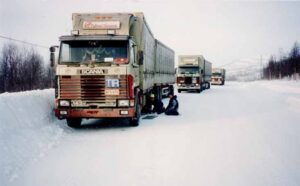
Fish Rally from Northern Norway 1987

Murmansk port awaiting loading.

Sometimes, the road between Rajajooseppi and Tulomaa (Murmansk) could in bad conditions.
An Innovation for Liquid Transports
Often, challenges can lead to innovations. We received a request regarding the transport of liquid fish silage. Therefore, together with Rukka, we developed a transport solution that enabled the return transport of liquid products. Below is a picture of the innovation.

Liquid fish silage loaded in “bags”.
Next Step in Development in 1988
At this point, together with the brothers, we began to think about our long-term strategy. We noticed some problems in the fur industry, especially the unstable market.
Therefore, we thoroughly reflected on our next step for the company’s development and future. The conclusion was as follows: Ahola Transport would invest in international transport for trade and industry, starting in the Nordic countries. The following question was asked: What offer and concept would we use to approach the market?
All major competitors had a strong position with large volumes. Their concept was based on strong and dense terminal networks. This model separates the collection, distribution and line traffic between the terminals. There were two reasons why we did not support this model: 1) we had no resources to build a terminal network and 2) we did not think the concept was particularly customer oriented.
Ferry Services: An Important Part of our Development
Until 1988, the ferry service was a bottleneck for smaller customers such as Ahola Transport. This was because the market had been dominated by major freight forwarders such as Scansped, Finnexpress, ASG, Huolintakeskus among others. With their rather large volumes, they were able to gain an advantage on the market with more favourable prices and advantageous crossings.
However, as luck would have it, a forward-thinking shipping expert appeared, with a fresh approach to the market. Christer Backman, former freight director at Viking Line, was entrusted to become managing director of the newly started ferry company FinnLink, which initially began operating between Uusikaupunki and Hargshamn in Sweden. Until then, ferry traffic for freight had been managed by the large logistics companies and ferry companies in consultation with the ports, where port fees play a significant role. Therefore, a slightly more unusual line was needed that did not previously have regular services between Finland and Sweden, so Uusikaupunki-Hargshamn became a good solution. This helped us on the road toward building robust growth together with the new ferry company.
In the beginning when Finnlink started up the business, at times only Ahola Transport’s trucks were on the ferry. Eventually other companies also started to find the line.
Our Dynamic Logistics Concept was Born in 1988
All competitors operated under the same business model: goods were collected at terminals using vehicles operating on fixed timetables, after which the goods were transported onward via long‑haul routes, also with fixed schedules. Together, with my brothers, we thought that the model probably served the logistics companies, but was not particularly good for goods owners. That is why our idea of the dynamic logistics concept was born, which in its simplicity, consists of smartly looking at customer needs on a daily basis and having the resources to carry out the transport according to the customer’s needs.
Our dynamic logistics concept is based on a reverse customer view; it is the customer’s need that governs, and not any collection, distribution or line timetables.
Today, at Ahola Transport, we have about 600 trucks that we control 100 % according to customer needs, and thus all combinations are available every second as our customers require.
To launch this model effectively, ‘bottom loads’ were required to enable full loading capacity. Therefore, it became relevant to find customers with heavy cargo, and the steel industry emerged as the most interesting target group. Once we had established this strategic direction, it became relevant to test it in the market in practice. As a result, I started up my Volvo 740 and headed for the largest steel company that I knew of, namely SSAB in Borlänge. There I met the Logistics Director Håkan Larsson. The meeting was a success.
According to Håkan, this was exactly what they needed: a supplier, that is not tied to any major freight forwarder. Our collaboration began the next week with a promise of two loads a week to Rettig’s factories in Jakobstad. This took place in the spring of 1988, and in the beginning of the autumn of 1988 we were contacted by Jouko Mikkonen at Rautaruukki Oy. The question was whether we could offer export shipments of steel to Sweden and Norway when their then supplier had announced that they were ending with their Nordic traffic. And this suited us perfectly. This gave us a real boost as Rautaruukki was also able to offer some import transports. Now the basis for our dynamic logistics concept was in place; heavy cargo at the bottom provided the opportunity for supplementation with light goods and thus a good fill rate.
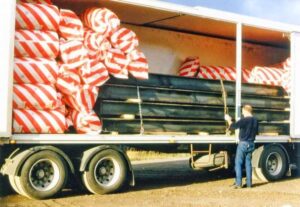
An example of how to supplement heavy and light cargo.
Thanks to this business model and dynamic logistics concept, our company has been able to grow into what it is today.
With the help of our digital platform with the possibility of real-time data and information, this development would not be possible. The foundation for our dynamic logistics concept was now laid and tested. We could already see that this will work to the satisfaction of our customers as well as to the improved profitability of Ahola Transport.
More on this in the next chapter relating to the 1990s.
Interesting People and Contacts in the 1980s
- Rolf Finne, Accountant
- Jan Vidberg, Managing Director at Iskalotten AB
- Stig Ventjärvi, Managing Director at Jääkala Ab
- Boers Skog, Managing Director at Scan-Auto Ab
- Mauri Vikeväinen, Managing Director at JIT-Trans (Rautaruukki)
- Jouko Mikkonen, Managing Director at JIT-Tans
- Karl-Johan Kronqvist, Haulier
- Christer Backman, Managing Director at Finnlink
Society
Political map of Finland:
Here is an overview of government composition of the government of Finland in the 1980s (1980 – 1989) – in other words, which governments ruled, which parties were included and who was prime minister in the meantime:
Finnish Governments in the 1980s (in brief)
1979 – 1982: Koivisto II government
- Prime Minister: Mauno Koivisto
- Period 26 May 1979 – 19 February 1982
- Party coalition: Social Democrats (SDP), Centre Party (KESK), Swedish People’s Party (RKP) and Democratic League for the People of Finland (SKDL)
→ This government started in 1979 and continued into early 1982.
1982 – 1983: Sorsa III cabinet
- Prime Minister: Kalevi Sorsa
- Period: 19 February 1982 – 6 May 1983
- Party coalition: SDP, KESK, RKP, SKDL (until the end of 1982) and later the Liberal People’s Party (LKP)→ The SKDL left the government at the end of 1982 due to disagreement over the defence budget, and the Liberal People’s Party entered.
1983 – 1987: Sorsa IV government
- Prime Minister: Kalevi Sorsa
- Period 6 May 1983 – 30 April 1987
- Party coalition: SDP, KESK, RKP, Finnish Swedish People’s Party and Finnish Rural Party (SMP)→ Known as a traditional “punamulta bloc” (red-earth coalition) with large parties and rural representatives.
1987 – 1989: Holkeri government
- Prime Minister: Harri Holkeri
- Period 30 April 1987 – 26 April 1991 (entering the 1990s)
- Party coalition: National Coalition Party (KOK), SDP, RKP and SMP (SMP left 1990)
This was a bourgeois majority coalition where the National Coalition Party was the largest party in the government.
It was also the first time in many years that the Coalition Party was allowed to lead a government when Harri Holkeri became Prime Minister.
Long-time Finnish president Urho Kekkonen had to resign due to health reasons. That Kekkonen sat as long as the president had to do with the so-called Finlandisation. It was considered that no one, but Kekkonen could lead foreign policy as well as relations with the Soviet Union.
Brief Political Context
- The Social Democrats (SDP) were a central coalition partner throughout the 80s.
- The Centre Party was involved in most of the early 80s governments but left in 1987 when Holkeri took over.
- The period was characterised by broader coalitions where several parties collaborated to secure a majority in the parliament.
Mauno Koivisto became President of Finland on 27 January 1982.
A Little Background:
- He previously served as Prime Minister several times during the 1960s and 70s.
- When President Urho Kekkonen resigned early in October 1981 due to health reasons, Koivisto became acting president.
- In the 1982 presidential election, he was formally elected president.
- He was re-elected in 1988 and remained in office until 1994.
What was the economic growth like in the 80s?
This is what economic growth in Finland in the 1980s looked like in general terms:
Broad Overview
- Stable and relatively robust growth for most of the decade
- Rapid credit expansion and financial liberalisation in the mid/late 80s
- Clear overheating towards the end of the decade, contributing to the crisis of the early 1990s.
- GDP Growth (approximate annual figures)
| YEAR | GDP growth |
| 1980 | ~5% |
| 1981 | ~1 – 2 % |
| 1982 | ~3% |
| 1983 | ~3% |
| 1984 | ~3 – 4 % |
| 1985 | ~3 – 4 % |
| 1986 | ~2 – 3 % |
| 1987 | ~4 – 5 % |
| 1988 | ~5% |
| 1989 | ~5% |
The average for the 1980s was around 3-4% per year, which was strong compared to many other Western European countries.
What drove growth?
- Export Industry
- Forest industry (paper, pulp, wood)
- Metalworking and engineering
- Trade with both Western Europe and the Soviet Union
- Financial market deregulation (mid-80s)
Under governments led by, among others, Kalevi Sorsa and later Harri Holkeri, the credit market was deregulated.
This led to:
- Strong increase in bank lending
- Real estate and stock boom
- Strong domestic consumption
Late 80s: Overheating
1988 – 1989 the economy grew rapidly but:
- Inflation increased
- Wages increased sharply
- Trade balance deteriorated
- Property prices rose rapidly.
This contributed to the deep financial and banking crisis of 1991 – 1993 when:
- The real estate bubble burst
- Soviet Union trade collapsed
- GDP fell sharply in the early 90s
In Summary
The 1980s in Finland were characterised by robust growth and a credit boom → overheating → crisis in the early 90s.
GDP growth in the 1980s Finland compared to Sweden
| Period | Finland | Sweden |
| Early 80s (1980 – 83) | Unsteady but recovering | Weaker start, low growth |
| Mid-80s (1984 – 87) | Stable 3-4% | 2-3% |
| Late 80s (1988 – 89) | 4-5% (overheating) | 2-3% |
Average 1980 – 1989
- Finland: approximately 3 – 4%/year
- Sweden: approximately 2 – 3%/year
Finland thus had slightly better growth than Sweden in the 80s. Today, the situation totally reversed with much stronger growth in Sweden than in Finland.
Transport Industry in the 1980s
Here is a summary of truck transportation in Finland during the 1980s – both vehicle stock and transport volumes. The figures are rounded (Statistics Finland/Transport authorities usually report them in spans), but they give an accurate picture of the development.
Number of trucks in Finland (heavy and light)
| Year | Registered trucks (approx.) |
| 1980 | ~150 000 |
| 1985 | ~165 000 |
| 1989 | ~185 000 |
Development
- Steady increase throughout the 80s.
- Particularly rapid increase 1986 – 1989 during the credit boom.
- The majority were light distribution trucks, but the number of heavy long-haul vehicles clearly increased at the end of the decade.
The industry was dominated by small and medium-sized hauliers, often family-owned.
Transport volumes (road freight)
Transport work (billion tonne-kilometres)
| Year | Ton-kilometres (approx.) |
| 1980 | ~18 – 20 bn |
| 1985 | ~22 bn |
| 1989 | ~28 – 30 bn |
→ Increase of about 40-50% over the decade.
Quantity of goods transported (million tonnes)
| Year | Million tonnes |
| 1980 | ~250 |
| 1985 | ~300 |
| 1989 | ~350 |
What drove the increase?
- Industry
- Forest industry (timber, pulp, paper)
- Metalworking and engineering
- Construction (especially late 80s)
- Credit deregulation
During the administrations of Kalevi Sorsa and later Harri Holkeri, among others, lending grew rapidly after the financial markets were deregulated.
This led to:
- More investment in trucks
- Increased domestic consumption
- Significantly increased construction activity
The role of the railway decreased slightly
VR continued to play a key role in transporting heavy bulk, though the flexibility of trucks caused road transport to gain a larger share.
Late 80s
During 1988–1989, long‑distance haulage increased sharply. This growth was accompanied by high levels of investment in vehicle fleets, while the overall economy showed signs of overheating.
When the crisis hit in 1991, transport volumes fell dramatically. Many haulage companies went bankrupt, and as a result, the size of the vehicle fleet declined for several years.
Summary
In the 1980s:
- The number of trucks increased by about 20 – 25%
- Transport volumes increased by about 40 – 50%
- Strongest growth 1986 – 1989
Substantial decline in the early 1990s
Important to understand about the 80s
As opposed to the present time:
- Few major national logistics giants
- No strong international competition
- Almost no foreign cabotage
- The market was more regulated and domestic
The industry consisted largely of tens of thousands of family businesses, often with strong local roots.
- The major players in international transport were as follows:
- Scansped, ASG, Huolintakeskus, Polar Express, Finnexpress, Kalottspedition
- Pohjolan Kuljetus, Viinikka, Teljän Kuljetus and the Ostrobothnian hauliers
- Paul Nyholm later Vaskitrans, Williamsson, Alf Ahlbäck, Lundberg,
- Sand Trans, Land Transport and Ahola Transport.
Maximum weights (ca 1980 – 1989)
Total weight (gross weight)
- 2-axle truck: approx. 16 tonnes
- 3-axle truck: approx. 22 – 24 tonnes
- 4-axle truck: approx. 26 – 30 tonnes
- Truck + trailer (rig):
→ Regular max: 42 – 48 tonnes →
In some configurations up to 56 tonnes (especially in forest transportation)
Finland thus allowed higher weights than many EC countries, where 38 – 40 tonnes were more common in the 80s.
Maximum lengths
- Truck without trailer: about 12 metres
- Truck with trailer: about 22 metres
- Modular vehicles (long timber vehicles) could last even longer with special permission.
Finland already used combinations with full-length trailers that provided high transport efficiency.
Max. width and height
- Maximum width: approx. 2.5 metres
- Maximum height: about 4.2 meters (Finland allowed higher height than many other countries)
The greater height allowance was important for:
- Forest products
- Volumetric goods
- Long-distance transport in sparsely populated areas
Special Rules for Forest Transport
The forest industry was central in Finland, and therefore there were:
- Higher permissible weights for timber transport
- Possibility of exemption on certain roads
- Heavy axle load allowed on custom road networks
This distinguished Finland from many Central European countries.
What happened in the 80s?
- Gradual upward adjustments in weight limits
- Adaptation for more efficient long-distance transport
- Preparing for future Nordic harmonisation
Finland was already at the forefront when it came to long and heavy vehicles, which later developed further (60 tonnes in the 1990s, → 76 tonnes in 2013, → even higher today).
Summary
In the 1980s, Finland allowed:
✓ Longer rigs than found many European countries
✓ Higher gross vehicle weights (up to ~48 – 56 tons)
✓ 4.2 m vehicle height
✓ Special Forest Exemption Rules
This meant that Finland had a very efficient but also heavily burdened road transport sector.
Source: Statistics Finland
I have now related my firsthand experiences from the so-called ‘cheerful’ 1980s.
Personally, I had a strong intuition that it would not last too long.
There is one event I recall – it was probably around 1988. We were on our way to Lapland to spend the winter sports holiday with the family. When we drove up to Lapland, we thought we would stop for lunch, but to our surprise, the restaurants were full. We had to search for a time to find a lunch place. Then I told Tiina that this party would soon end. A few years later, we know what happened.
Again, an important reminder of intuitions. In 1989, we had bought a plot of land to build ourselves a new single-family house. The plan was to sell the terraced flat once the house was finished but once again, I had a sudden intuition that we should sell the flat immediately.
I posted a sign by the road advertising the flat for sale. I knew that quite a few would come just out of sheer curiosity. I made a mental decision that the first person to bid near the asking price would be the one I would negotiate with, adjusting as necessary to make the deal happen.
This turned out to be a good strategy. The home was sold again in 1991 and by then the price had fallen radically.
Hans Ahola
Chairman of the Board
Ahola Group