
The 1990s – a period of strong development and growth for Ahola Transport
After a strong finish to the 80s, Ahola Transport also got off to a very good start in the new decade. This was thanks to our new dynamic logistics concept, launched in 1988.
One tends to forget things one has lived through. Now, as I began writing about the 90s, I became aware of what a fantastic development we experienced during the decade. Until 1992 we had no ERP system, only a few individual computer programs for invoicing, bookkeeping, word processing (Write) and Lotus 1-2-3.
Our very strong growth also brought practical challenges. As we lacked an ERP system, invoicing was based on physical consignment notes. It often took 2–3 weeks before we received the consignment notes for invoicing. This ultimately led to cash-flow challenges, as our costs came with 14-day payment terms while sales were on terms of up to 30 days, plus the delay in invoicing.
Between 1989 and 1991 I completed an entrepreneur’s diploma at Johtamistaidon opisto in Kirkkonummi. This period gave me a very good theoretical frame of reference for what I had learnt through practical leadership. It was incredibly motivating to study and develop my own skills. What I enjoyed most was drawing up strategies and business plans. During the final year of study, one of the lecturers was Riku Lehtinen from Tuloksentekijät, who had developed a very good and effective tool for simulating complete business plans.
The result was that I bought the IT tool Optima precisely for the purpose of drawing up and simulating business plans. Over the following 15 years I used the tool successfully, simulating targets three years at a time. Together with Tiina, we had applied the method of breaking down all income and costs into markka per kilometer, which was a great help when I started the simulations.
Working capital financing
Even though we were highly profitable and growing strongly, we received no loans from the banks. So we began to think about how to arrange our working capital. Our financial partner was the accounting and auditing firm Rolf Finne. Rolf tipped me off about the State Guarantee Board, which had been established through legislation in 1989.
The Guarantee Board – how did it come about?
The background was that the state wanted to consolidate and streamline various forms of state guarantee and financing activities. Above all, the new Guarantee Board was to:
- provide export guarantees to promote Finnish exports,
- provide state guarantees for corporate financing,
- improve access to risk financing, especially for small and medium-sized enterprises,
- and in this way strengthen companies’ financing opportunities.
In the government bill for the 1989 act, the Guarantee Board was explicitly defined as a state body that would conduct financing activities through guarantees and other guarantee commitments. It was specifically to improve small and medium-sized enterprises’ access to risk financing.
But as usual, the decision-makers in their wisdom had excluded certain industries that could not be financed, and among them was the ”sensitive” transport industry. The first answer to Ahola Transport’s application for a state guarantee was therefore no.
As an entrepreneur, you don’t give up that easily. So I invited the contact person for Ostrobothnia, Simon Indola, to visit. I did my homework well, with a presentation of our financial statements and a profitability simulation for the three years ahead.
To get around the rules concerning the sensitive transport industry, I constructed the following argument.
Ahola Transport’s operations are 100% export activities. When we transport export goods for Finnish customers, the product value also includes the transport share, which we invoice to the exporting company. The total value of the product and the transport service thus becomes 100% export. When we then acquire foreign import customers and carry out import transports, the invoice is sent to the customer.
Ahola Transport’s operations are therefore 100% export activities. With these arguments, I was able to prove that the service sector, too, is an export activity and contributes to Finnish exports. Sometimes you have to ”bend it out of iron wire”, as the Finnish saying goes, to explain a simple thing.
With these arguments, Simon Indola was able to secure a positive decision on a state guarantee of 5 million. Afterward, I heard from Simon that his superior had asked him what connection he had to Ahola Transport. This was because Ahola’s operations and address are at Indolavägen 33 and Simon’s surname is Indola.
Simon replied that if someone has Kotka as their surname, it does not mean they own the city of Kotka.
The guarantee came through and our working capital problem was solved. I remember well when our CFO called me and told me that all invoices were now paid and there were still 3 million left in the account. What a relief and gratitude!
Finland faces its deepest recession since the war
But let me begin by highlighting the storm clouds that anyone with a bit of common sense could discern. The situation was incredibly overheated, due to the total deregulation of the credit market.
Personally, I particularly remember a TV advert from this period. The memory goes like this: two bank managers came out onto the street in front of the bank, pushing a wheelbarrow full of money: ”Entrepreneurs, come and get it – we have as much money as you could ever want!”
The great mistake of Finnish monetary and currency policy in the 1980s is usually described as a combination of several decisions that together led to the deep economic crisis of the early 1990s.
Below are some examples and effects, drawn from public sources:
1. Deregulation of the credit market without sufficient safeguards
In 1986 the credit market in Finland was deregulated. Banks were given greater freedom to lend money, and households and companies could borrow considerably more than before.
Consequences:
- A sharp increase in lending.
- Rapidly rising property and share prices.
- Households and companies took on heavy debt.
2. Defending the fixed exchange rate
The Finnish markka had a fixed exchange rate, which the Bank of Finland tried to defend.
The problem was that:
- The credit expansion increased inflation.
- The Finnish cost level rose faster than in many other competing countries.
- The currency became overvalued.
Despite this, the authorities held on to the exchange rate for a long time instead of adjusting it earlier.
3. High interest rates to defend the markka
To defend the fixed exchange rate, interest rates were raised sharply as pressure on the markka increased in the late 1980s and early 1990s.
This led to:
- More expensive loans.
- Problems for heavily indebted companies and households.
- Falling property prices.
- Increased credit losses for the banks.
4. Encouragement of foreign currency loans
Many companies, and even some private individuals, took out loans in foreign currencies because the interest rates on them were considerably lower.
When the markka was later devalued and then allowed to float freely in 1992, the consequences were devastating:
- Foreign currency debts increased sharply in markka terms.
- Many companies ran into serious financial trouble or went bankrupt.
5. Devaluation and the move to a floating exchange rate came too late
Many economists believe the authorities defended the fixed exchange rate for too long.
When the markka was finally devalued and later floated in 1992:
- The property bubble had already burst.
- The banking system had suffered heavy losses.
- Unemployment had risen sharply.
Here is an example of the consequences during those years:
According to the Bank of Finland and Statistics Finland, the number of bankruptcies developed roughly as follows:
| Year | Number of bankruptcies |
| 1990 | 3 588 |
| 1991 | 6 155 |
| 1992 | 7 348 (peak) |
| 1993 | 6 769 |
| 1994 | 5 502 |
This means that:
- Between 1990 and 1992, the number of bankruptcies more than doubled.
- 1992 was the worst year of the crisis.
- After that, bankruptcies began to decline, but remained at historically high levels for several years.
How serious was it?
The Bank of Finland estimated that around 5% of all companies went bankrupt in 1992, an exceptionally high bankruptcy rate. Many small and medium-sized companies disappeared, particularly in:
- construction
- trade
- the property sector
- as well as companies with large foreign currency debts.
Overall, the statistics show how dramatic the Finnish 1990s crisis was: the number of bankruptcies rose from around 3 600 in 1990 to over 7 300 in 1992, while unemployment rose from about 3% to over 16% and GDP fell by around 10% within a few years.
The result: the Finnish crisis of the 90s
The combination of a credit boom, an overvalued currency, high interest rates and collapsing asset prices contributed to the deep Finnish banking and economic crisis of 1991–1993.
Many researchers therefore see the biggest mistake as deregulating the credit market without simultaneously adjusting monetary and currency policy. The combination of free capital movements, rapid credit growth and a fixed exchange rate proved very difficult to manage.
An important background factor was also the economic shock following the dissolution of the Soviet Union, which meant that a significant export market for Finland disappeared just as the domestic financial crisis worsened.
Foreign currency loans were still being offered and pushed very actively by the banks in the early 1990s.
We at Ahola Transport were also greedy enough to accept this, which at the time seemed like an attractive offer.
The Finnish markka was devalued in 1991, and the following year, 1992, the markka was floated, losing further value.
We at Ahola, too, had to conclude that foreign currency loans were neither a good nor a profitable solution.
If I remember correctly, we wrote the loan down – or rather up – as the currency loan had become 600,000 markka more expensive.
As our results were at a very good level in those years, we could write off the currency loss without jeopardizing the overall result.
How did Ahola Transport enter the new decade?
As I mentioned earlier, our operations were already going strong at the end of the 80s.
Much of it was down to our new strategy and our dynamic logistics concept. Our simple way of looking at logistics was about matching customer needs with resources as efficiently as possible.
As well as applying fact-based decision-making processes, by breaking down figures and facts into understandable daily work that everyone could grasp and feel part of.
Ahola Transport got a flying start to the decade, followed by strong annual growth throughout the 1990s. We grew the business tenfold from 1990 to 2000. The business was also highly profitable, with an average profitability of just over 8%. It is really quite incomprehensible.
Clearly, this would not have been possible without highly motivated and committed people. We built a very strong company culture that lives on and thrives to this day. The cornerstones of our culture are our values.
But in all honesty, we have, like everyone else, also had failures and made wrong decisions.
You can read about those later, too.
In the chapters below you can read in more detail about how we managed this in practice.
- Financing
- New facilities
- The introduction of new digital solutions with our first ERP system.
- Business simulations and business plans
- Innovative and efficient transport solutions
- The decision to build our own concept-based IT system
- New customer concepts
I will begin with the construction of our new office, as it is chronologically the right time.
Our premises and facilities
Our office space was in the hall built in 1982, which was used right up until 1991. The premises consisted of two rooms totaling about 35 m². As I was mostly out selling transport services, I only had standing room there.
Nils handled transport planning, while Lars and Rolf ran the workshop operations. Tiina was our first so-called office employee, and quite soon Lars’s wife Ann-Charlotte also started working in the office. Later our sister Britt-Mari joined too, so you can understand why there was only standing room left for me.
So we decided to buy more land in order to build a new office.
The office
The office construction itself was a slightly unusual story. We were used to doing as much as possible with as few resources as possible, so as not to waste money unnecessarily.
At this time we were still carrying concrete elements for our customer Rajaville in Oulu. One day I received a phone call from them saying that there was a batch of wall elements that had to be scrapped or reused. I was offered them for free, since the cost of scrapping them was quite high for them.
We naturally said yes, even though at that stage we did not yet know how we would use them. They had been in storage at our yard at Indola for over a year.
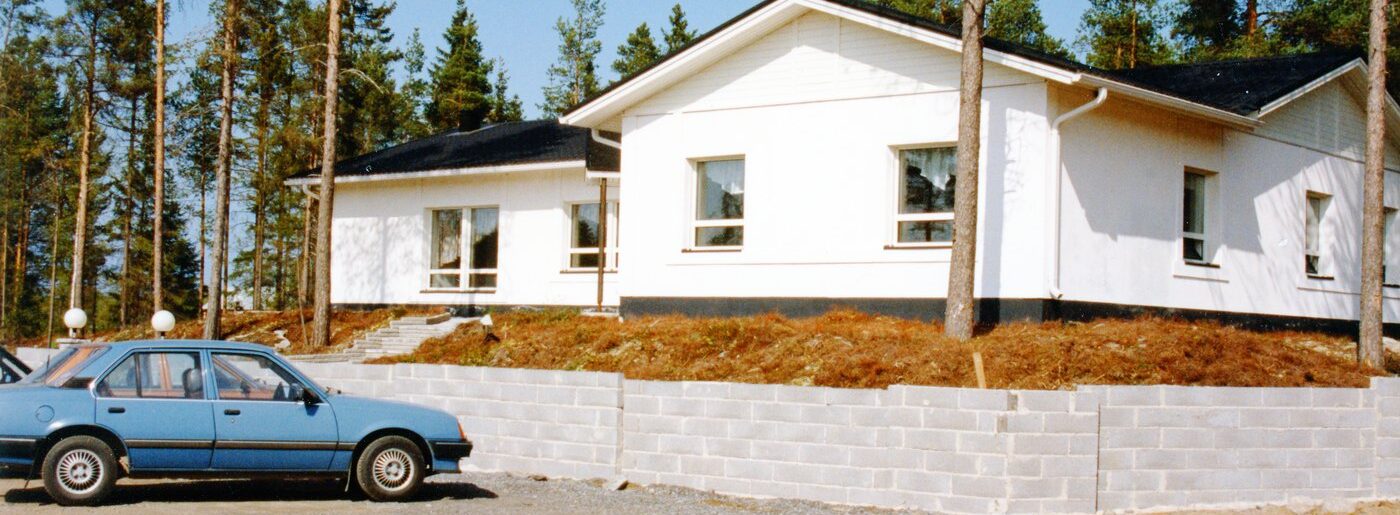
When the planning of the office building got under way, I went out to measure how many metres of wall elements we had. I called a master builder I knew, Sven Åkerlund, and told him how many metres of wall elements we had. He was then given the task of designing an office as large as the wall elements would allow.
This is how far the wall elements stretched:
A top-notch office
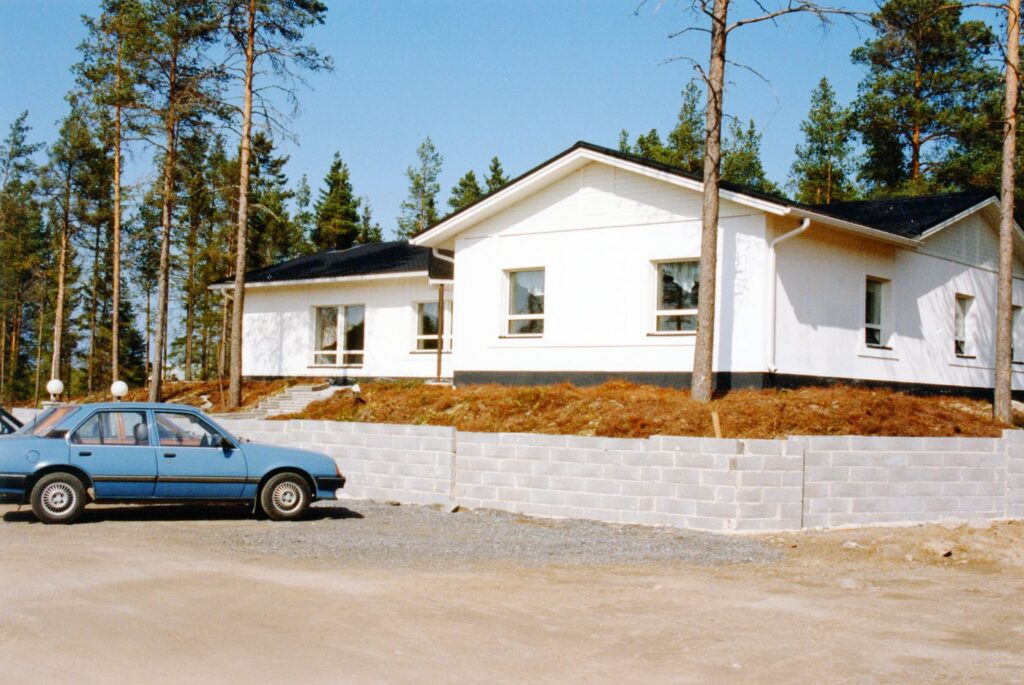
Top-notch premises
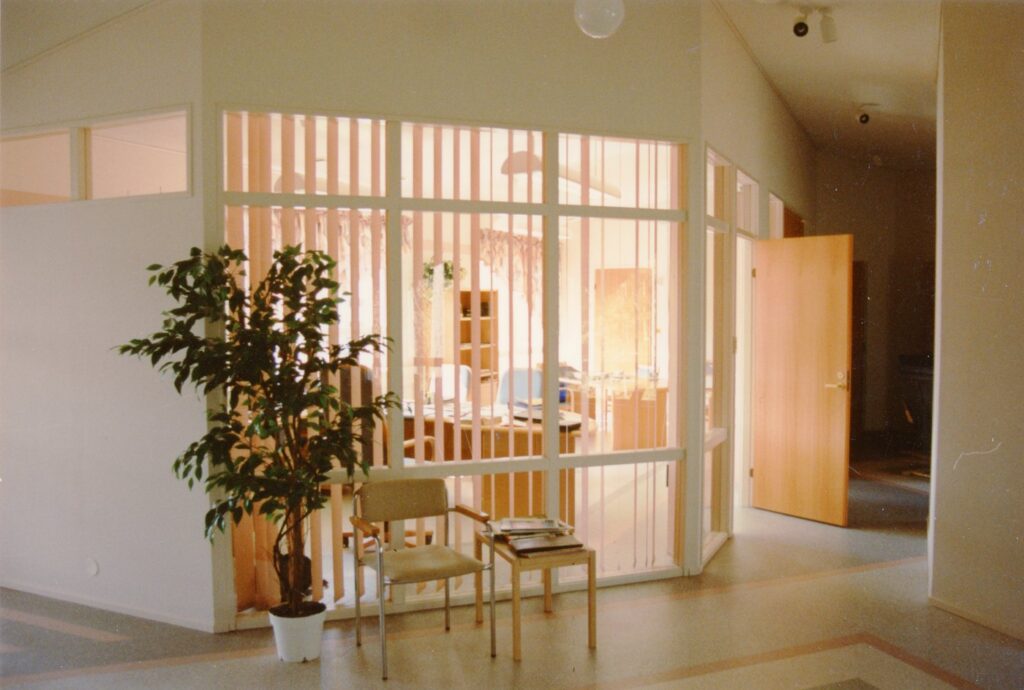
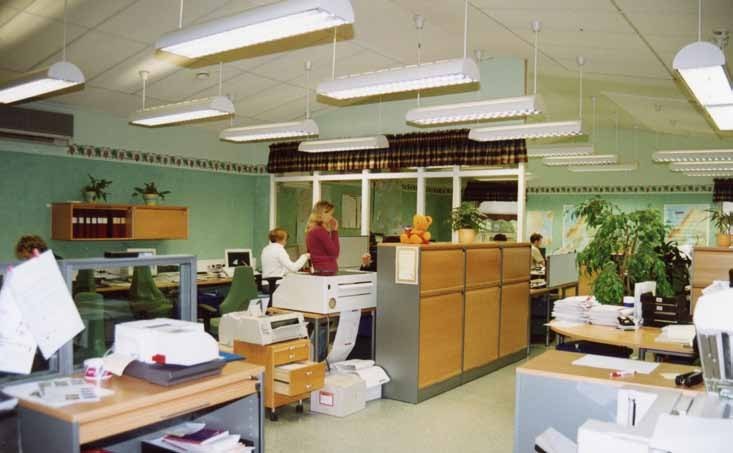
As the business grew strongly, it wasn’t very long before an extension was on the agenda.
Education and leadership
Personally, I had long been planning to educate myself further in leadership. I looked at various options and found the best alternative in an entrepreneur’s diploma offered by ”Johtamistaidon Opisto”. It was a very high-quality two-year program consisting of contact days and distance learning with homework assignments. My basic education, after all, was primary and civic school.
I had planned to start studying at the commercial college at the end of the 70s, but a number of things got in the way that made it impossible. The main reason was that our father fell ill with cancer.
I was incredibly motivated to improve myself through my studies. What gave me an extra push was realising how much benefit I got from the practical experience I carried with me. I could see that I had something to offer my fellow students as well.
Through my studies I gained a solid theoretical frame of reference that reinforced my practical experience. I also acquired suitable methods and tools for planning and simulating the future of our company.
Simple tools such as SWOT and other methods became more useful and familiar through the studies.
What I enjoyed most was drawing up strategies and business plans.
As I mentioned in the introductory section about Tuloksentekijät and the Optima simulation tool, I gained a solid platform to plan and build on. Timo Tiilikka and I worked for about 3–4 days straight to put together a business plan for the three years ahead. Producing the plans was highly motivating work. What’s more, I got to see that it also worked in practice.
The end result was that I bought the IT tool Optima precisely for the purpose of drawing up business plans. We were never disappointed during the 15 years we worked with it. The method was incredibly reliable, especially as we had an organisation striving to make it even more effective in practice. I don’t think we ever produced a result below plan during those years.
Together with Tiina, we had applied the method of breaking down all income and costs into reliable facts in markka per kilometer, which was a great help when I started the simulations.
Breaking data down into facts and simple, understandable models made it much easier to understand how everything works in practice. Above all, and most importantly, you can explain to the organisation how income and costs arise and the relationship between them. With this simple method we obtained the sales margin per unit and per kilometer.
It was therefore a natural development and the next step in what we later – and still today – called ”tiedolla johtaminen”. Some words are much more effective in Finnish, and one of them is precisely ”tiedolla johtaminen” (knowledge-based management). I honestly don’t know how to put it simply in English – perhaps” data-based business” or” information-based management” or something similar.
The practical method we used was to break down the previous year’s income statement into income and costs in markka per kilometer. We then segmented into separate market areas, e.g. domestic Finland, Finland–Sweden, Finland–Norway and Denmark.
Next, we segmented the various transport units into different ”product ranges”: truck and trailer combinations, truck and semi-trailer, and the special combinations.
As the kilometers driven were available for each combination, it was fairly straightforward to break down the figures from the financial statements according to the model above into income and costs per unit for that financial period.
In this way, the financial statement figures were simulated and cross-checked through summations back to the financial statements, which had been reshaped into income and costs according to the plan laid out with market areas and segments.
The Optima program also included a function for managing the balance sheet. Quite powerful to get a truthful picture of the state of the business in this way, especially for getting cash flow under control.
With this model we laid the foundation for ”reaaliaikaisella tiedolla johtaminen” (real-time knowledge-based management), which later laid the groundwork for building our own digital logistics platform, Attracs.
The great reassurance was also the direct link to the balance sheet, including cash flow calculation.
We used the Optima tool well into the 2000s.
The whole of the 1990s was a period of very strong growth for Ahola Transport. Stronger at the beginning, somewhat more moderate later on. But this period was very interesting and eventful. It included new business areas and the winding down of a few smaller ones.
Ahola’s way of working: the Workbook (Ahola Way)
As the business grew, it was high time to clarify the strategies and foundations of our company.
In 1994 we began working with the advisor Lars-Erik Thylin. Lasse was a very good partner to work with. After a while we could see that Lasse was quite good at interpreting what I was after. Lasse has very long experience as an entrepreneur in the clothing and boat industries. He has a head for business and an understanding of, among other things, market trends and societal development.
I felt I needed an outside sparring partner to structure my own thoughts on how we should work. I wanted to build a tool to communicate Ahola’s way of working and the foundations of the business clearly and simply. With the background and support of the studies I had completed at Johtamistaidon Opisto, complemented by my practical leadership experience, Lasse and I began sketching the first version of our strategy document, the ”Workbook”.
Lasse was very good at documenting and describing things, so he acted as secretary. It was also important for us to visualise as much as possible. As they say, a picture is worth a thousand words. Our workbook has lived on to this day and is now called AHOLA WAY.
It is fair to say that it was very important for Ahola Transport’s future that we documented and framed our operating principles in a strategy document. And the most important part was, and still is, our values. The values are the same today as they were then:
Total responsibility = we agree on how we do things, and that is how we do them.
Openness = when things did not go as agreed, we immediately raise what went wrong so we can correct it quickly. Openness also means: we talk with people, not about people.
Respect for the individual = everyone has the same human value to us.
Our values are to guide our daily actions. Today, the values are written into all employment contracts for approval.
I dare say that our values are what have created the very strong company culture we have at Ahola.
The Workbook was structured around visions for ten years ahead. The first ten-year vision set a target of a turnover of 170 million markka. That turnover level was reached as early as 2003.
The Workbook became a concrete strategy tool primarily for the employees of Ahola Transport. It described the company’s vision, business idea and the strategies for achieving the visions.
Transport capacity and development
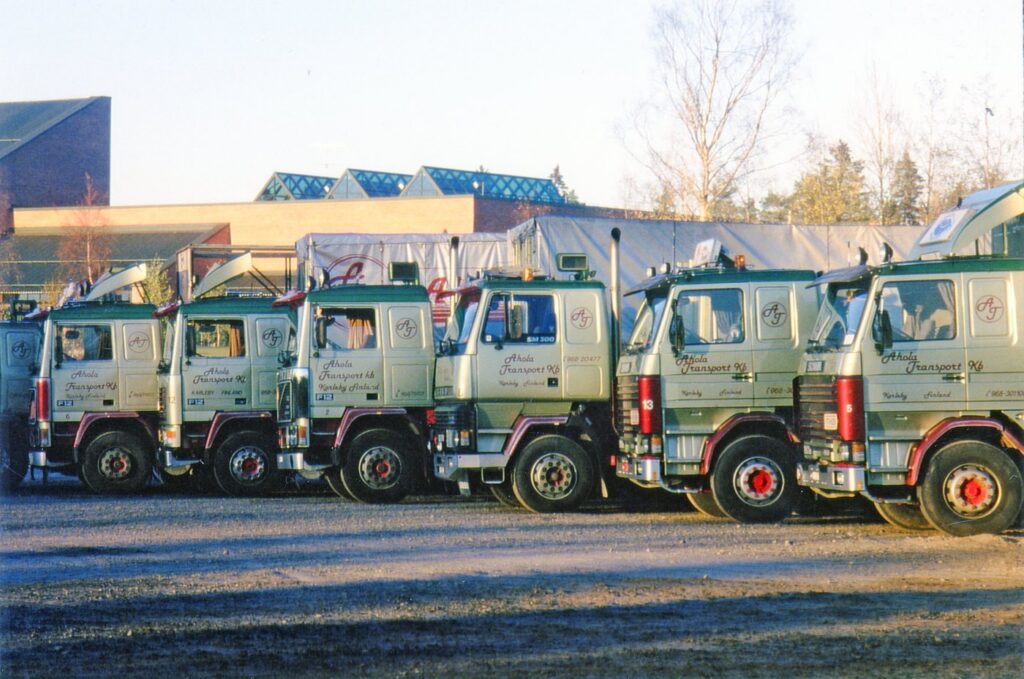
Fuel transports had been part of our operations since 1965, through transports for Union-Öljyt Ab. Already in the 80s, some consolidation took place in the oil industry when BP’s operations and Union were merged into a joint venture. Later, that entire business was bought by Neste, which also acquired Kesoil from Kesko and E-Öljyt from Elanto Oy.
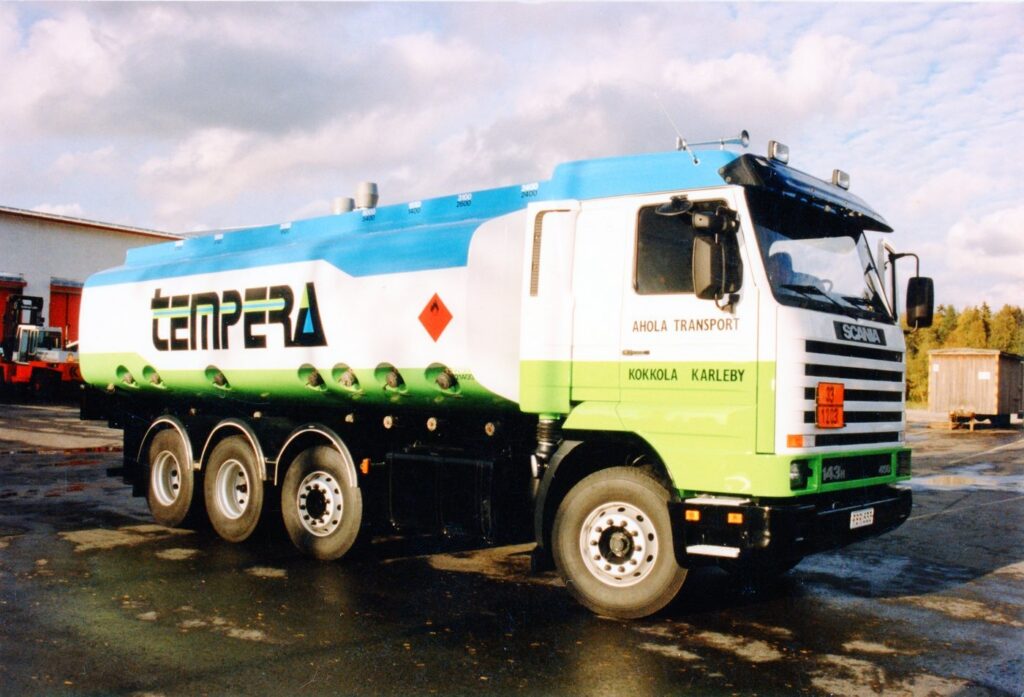
As our international transport operations grew so strongly, we decided to sell off the last part of our fuel transports, which happened in 1998.
In the same year, 1998, we started a new segment when we signed an agreement with Scania for chassis transports of new trucks from the factory in Södertälje.
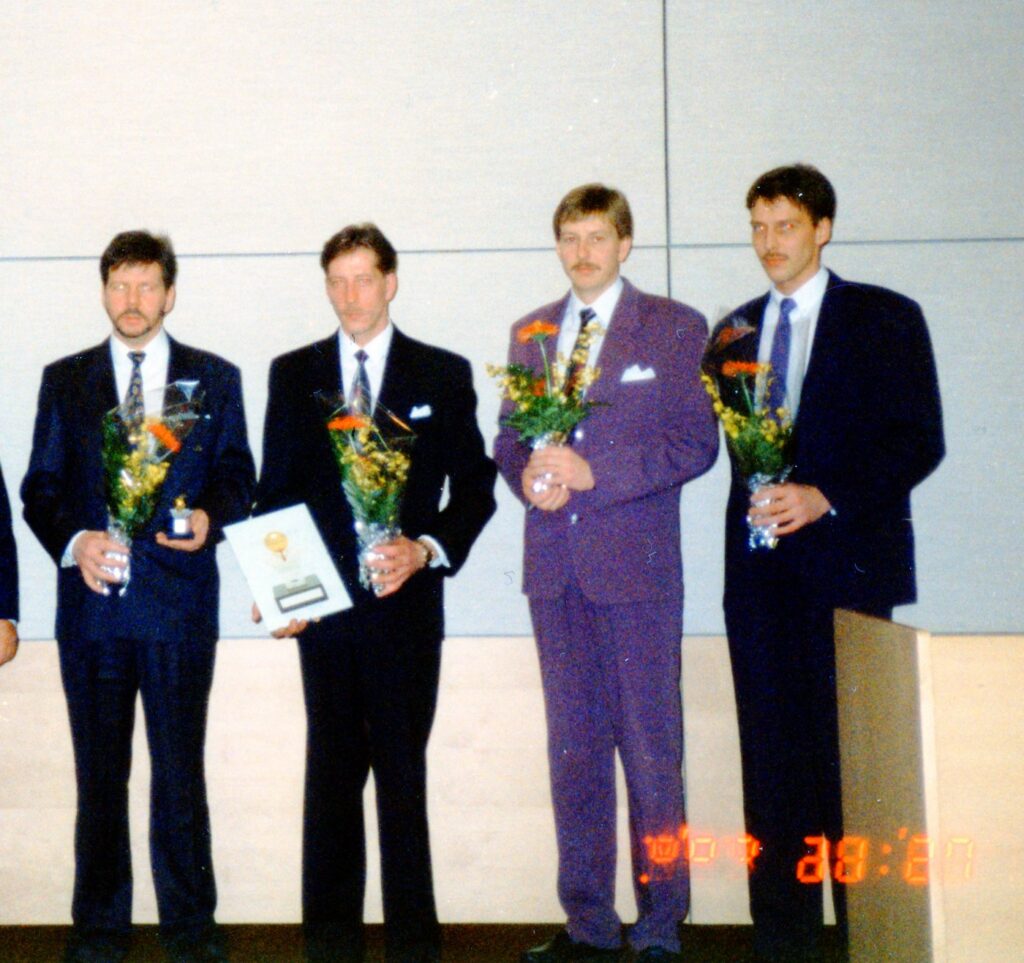
Entrepreneur of the Year in Kokkola 1993
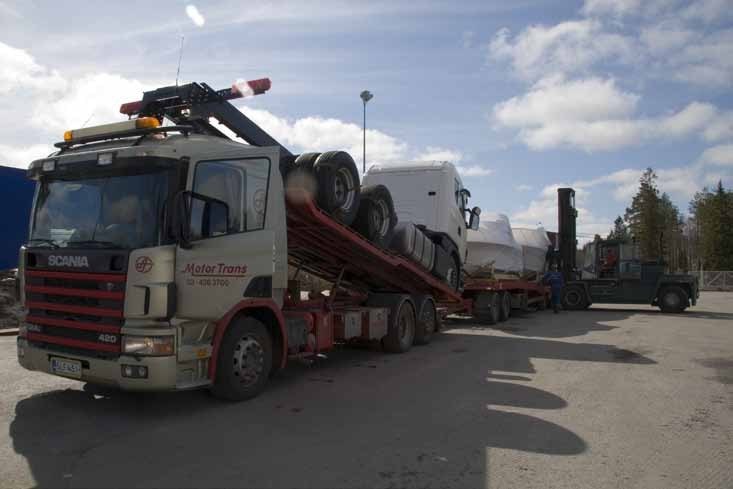
A new concept and offering. The first agreement with Scania for chassis transport to Finland
Interesting cases and memories
An interesting case took place in the summer of 1991, when we were offered the job of transporting building materials to Arkhangelsk in the then Soviet Union. To explore the possibilities of return loads, I sent a letter to Sovtrans Auto, which held the monopoly on international transports in the Soviet Union.
I don’t remember how I found the contact person, but in any case I sent the letter, which was the only option in those days. Fax would have been another alternative, but unfortunately I didn’t have the number.
The interesting thing about this was that I sent the letter on 21 August 1991, and a few days later the Soviet state collapsed.
The great transformation in the transport industry came when the needs assessment for transport licences was abolished. This meant you could freely apply for as many transport licences as you needed. The only requirement was that you had been active in the industry as a transport manager. In addition, a bank guarantee of 30,000 markka was required for the first licence and 15,000 markka for each subsequent one.
Previously, it was quite bureaucratic and difficult to obtain new transport licences. This also led to an unhealthy trend, as the industry began inventing arguments for so-called product-specific transport licences.
I have experience of this myself. In the early 80s we received an enquiry from Rautaruukki about transporting long pipes to Norway. There was plenty of feed fish from northern Norway for return loads. With the arguments above, we were granted a transport licence for precisely these products: export transports of steel pipes and imports of feed fish.
Seen through today’s eyes this was of course absurd and unhealthy, but that is how regulated the transport industry was in those days. Fortunately, liberalisation became a reality.
Throughout the years, we at Ahola have had a strong will to develop the business. The focus has been on making operations more efficient – doing as much as possible with as few resources as possible.
The keyword has been ”total energy efficiency”, which is why emissions issues have always been a natural part of our thinking. The gratifying thing, of course, is that energy consumption and profitability go hand in hand more than well.
As part of this, we have always tried to find ingenious solutions to increase efficiency. In the 80s we launched an internal slogan: ”more goods on fewer trucks”.
The formation of the subsidiary Limetec
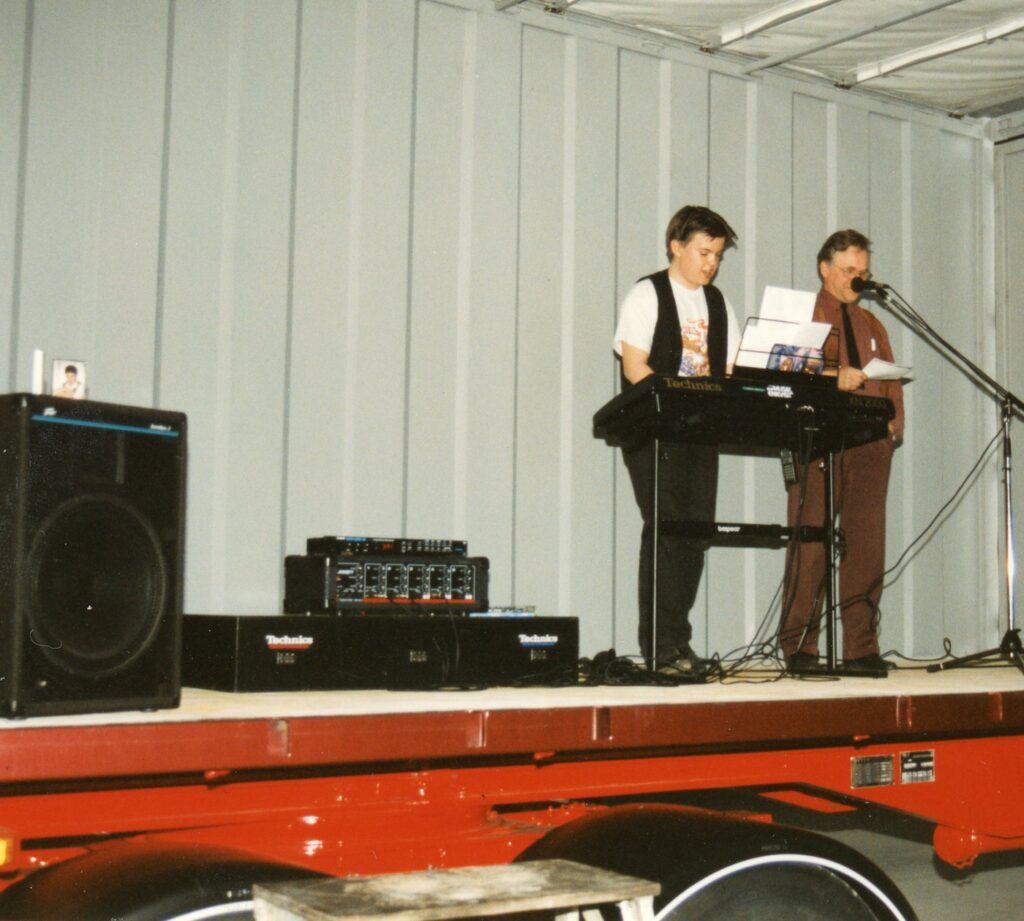
Topping-out party for Limetec’s production facilities. In 1995, we incorporated our workshop operations and formed Oy Karleby Limetec Ab.
The company Oy Karleby Limetec Ab
As we enjoyed great success at Ahola Transport, there was a real risk of being blinded by speed. That is exactly what happened when we formed Karleby Limetec Ab, as we would later learn. We were both naive and a little cocky – we thought we could do anything.
Brother Lars was responsible for the workshop operations, so it was natural that he became the managing director of the company. Our workshop had been doing quite extensive work ever since the early 1980s. We had made major modifications to trailers and superstructures,
We lengthened, shortened and fitted additional axles, and if I remember correctly, I believe that already as a workshop we built our first new trailer. Ahola Transport benefited enormously from Limetec.
The success concept AT Heavy Load
The very idea for the Heavy Load concept was born when one of our transport planners came to me and said that SSAB Borlänge is so ”out of the way” and there are hardly any other customers nearby whose goods could supplement the heavy steel loads.
That got me thinking about alternatives. In what way might it be possible to supplement with more steel instead?
So I went over to our then subsidiary Limetec and brother Lars to think the matter through. My advice was: strip away as many components and as much weight as possible to create maximum payload. Even then, I knew this would become a success factor.
It turned out there was incredible potential. We could gain up to 4 tonnes more payload, which meant enormous efficiency gains, lower emissions and considerably better profitability.
The first so-called ”AT HEAVY LOAD” combinations were built in 1997 at Limetec.
My brother Lars was given free rein to propose a combination that was as lightly built as possible. We at Ahola promised that the combinations would not need any warranty; the buyer would take responsibility for that. The result was incredible, with a tare weight of just over 16 tonnes.
Everything unnecessary was left out – even the spare tires were removed from all combinations. The total effect of leaving out the spare tires, for example, amounted to the of equivalent of two fully loaded combinations carrying spare tires. We thought it was better to transport our customers’ goods, which we were paid for.
Nonetheless, Limetec has become a very strong brand, especially in Sweden and Norway. Limetec superstructures are very durable and cleverly functional.
What we unfortunately did not succeed in was achieving sustainable profitability. The heavy blow came after the 2007 financial crisis, when the market fell away. On top of that came the fall of the Swedish and Norwegian kronor. We fought on for a few more years, but we had to face the facts. We were not competent to run a manufacturing industry.
The Limetec company was declared bankrupt a few years later.
The great benefit for the Ahola companies has been the incredibly many smart transport solutions that we developed together with Limetec, which have given us tremendous competitive advantages.
But running industrial production was beyond us.
Our own ERP system ATTRACS
(Ahola Transport, tactical, recognizing and coordination system)
In 1998 we began building our own digital logistics platform. Even then, we decided that we must be able to measure actual emissions for everything we transport. To this day, we plan and carry out the most efficient, low-emission transports in the industry using this digital logistics platform. In practice, we plan our operations based on real-time data.
This enables us to report actual emissions for each shipment separately.
Naturally, we can report emissions according to the customer’s needs and for any time period. Through our customer portal, the customer can access all data and factual information about the execution in real time.
This is something very interesting! In the 90s we had no ERP system to manage our operations. We scanned the market to find a good tool for our daily business. There were extremely few suppliers with ERP systems specific to the transport industry.
But we found Transman, which we felt could meet our biggest needs – namely, being able to enter bookings with sufficient information so that we could then invoice.
Our big problem was getting the consignment notes in from the trucks in time to invoice. It could take several weeks for the consignment notes to come in, which led to poor cash flow. With all purchases on 14 to 30-day payment terms, you can understand how that can lead to the cash till running dry.
At the beginning of 1993 we were able to take the Transman ERP system into use, which helped us get our cash flow on the right track. I remember well when our CFO called and told me that all invoices had now been paid and 3 million markka remained in the account – what an incredible relief.
However, Transman was a DOS-based system, while all new systems were Windows-based. In 1995 the new version, called TransEumu, arrived and was Windows-based. It helped us a little, but did not fulfil all our wishes for our dynamic logistics concept.
Our dynamic online concept requires fast solutions delivered efficiently. TransEumu was built for logistics companies with the traditional concept of collection to terminals, line-haul between the terminals and distribution. It was therefore difficult to extract the benefit we needed.
Since there was no ready-built system on the market that directly served our concept, the idea grew that we had to find a solution ourselves. The first thoughts of building our own system arose together with Rolf Lampa in 1996, when Rolf was building our new quality system.
The culture and strategy of the Ahola group have throughout the years been based on a few decisive main principles and success factors:
- Strong entrepreneurship, a strong and forward-striving culture
- Highly motivated and committed people
- Solution-based operations – we always find a solution
- We give room for taking responsibility
- A culture of innovation: think differently, nothing is impossible
- Strong, lasting values that have created a strong company culture
- Fact-based and real-time management and leadership
- Fact-based simulation
- Focus on digitalisation
- Constant efficiency improvement: more goods on fewer trucks. The kilometre not driven is the most environmentally friendly one.
- The courage to try new technologies
Along Ahola Group’s journey through the years, the green transition has in fact always been present. Countless special solutions have been realised over the past 45 years. The main focus has always been on doing as much as possible with as few resources as possible.
Special innovations and transport solutions
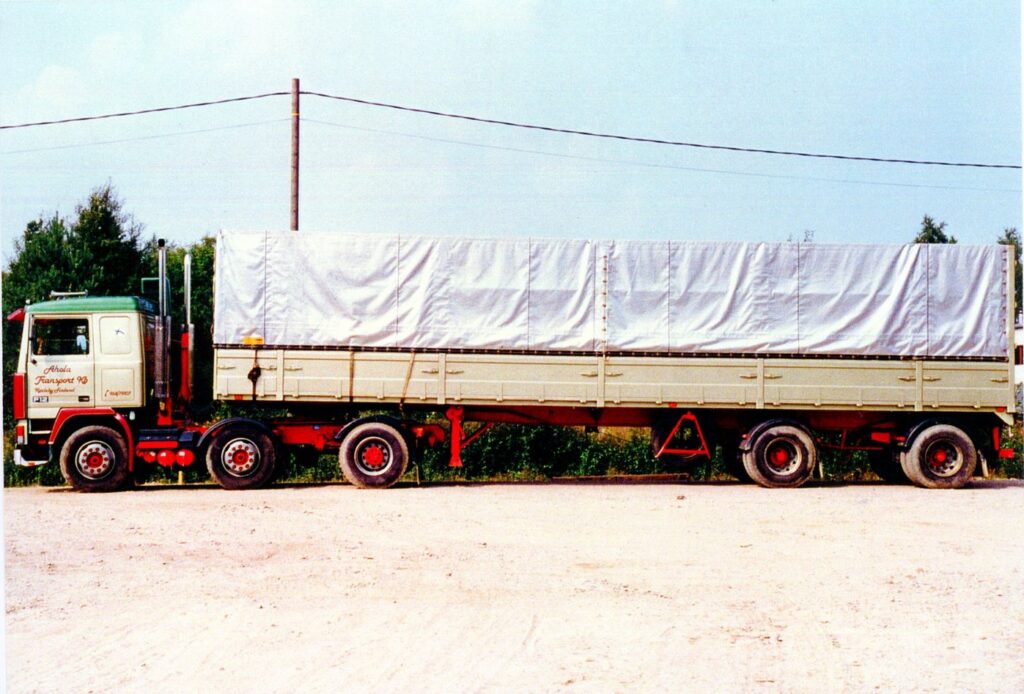
1984: This combination gave 3 tonnes more total weight thanks to the wheelbase solution on the tractor unit.
This was not a factory solution but had to be customized in Finland. Lower emissions, better profitability
1984: A solution that unfortunately is not pictured is the so-called A-frames for tall concrete wall elements. The traditional model was an element rack that took up the entire load bed, removing the possibility of return loads. This solution was unique, but unfortunately it was never patented. Even so, we benefited greatly from the solution for many years. Lower emissions, better profitability.
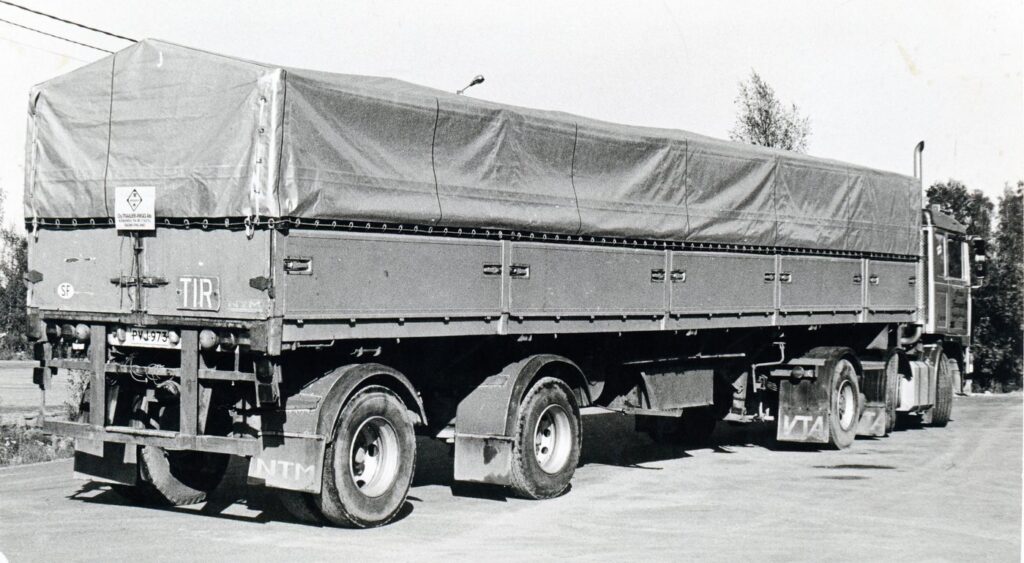
1985: With this extendable trailer we carried long goods for export – steel pipes, beams, posts and more. With this tarpaulin solution we could carry feed fish on the return leg. Lower emissions, better profitability.
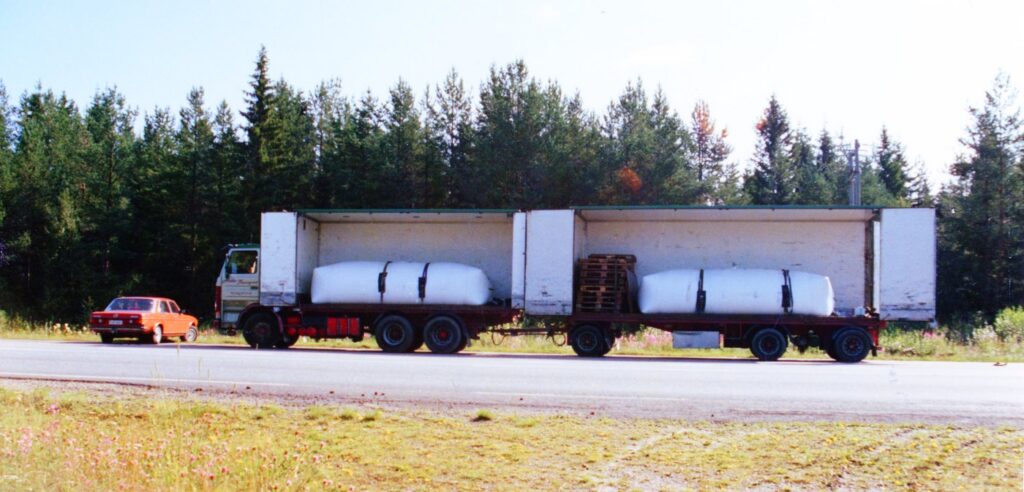
1989: This solution was developed together with Rukka. There was a shortage of feed fish from Norway, but liquid fish silage was available instead. With this solution, we secured loads in both directions. Lower emissions, better profitability.
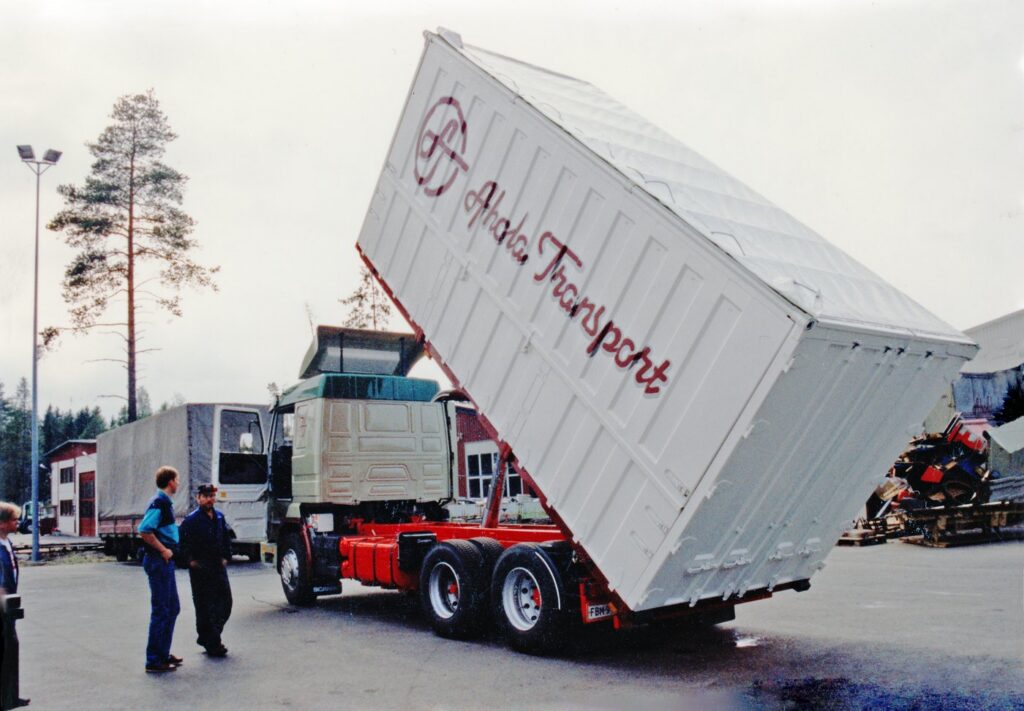
1994: Our subsidiary Limetec built this special combination for recycling transport (scrap metal). It enabled loads in both directions. Lower emissions, better profitability.
1998: To transport long chassis, we had to cut away part of the rear of the cab.
Here, too, an efficiency gain: transporting chassis with boats as supplementary cargo. Lower emissions, better profitability.
1998: ”More goods on fewer trucks was our internal slogan”. Lower emissions, better profitability.
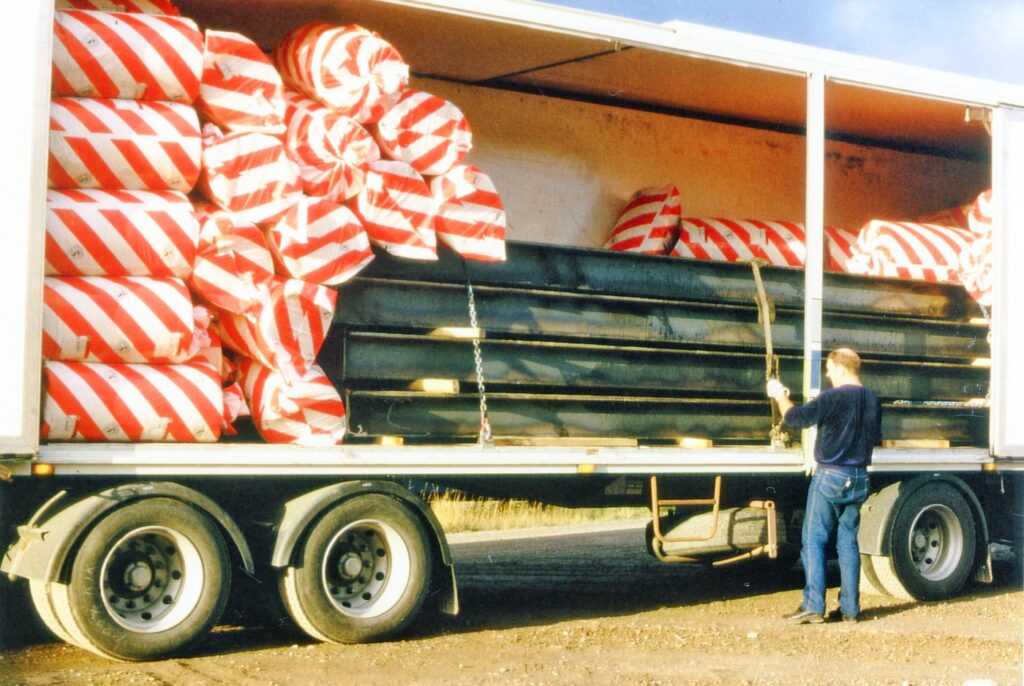
1996: As we transported a lot of steel – and still do – it is important to combine heavy and light goods. This gives an incredibly good load factor when you add up tonnes + freight weight. ”More goods on fewer trucks was our internal slogan”. Lower emissions, better profitability.
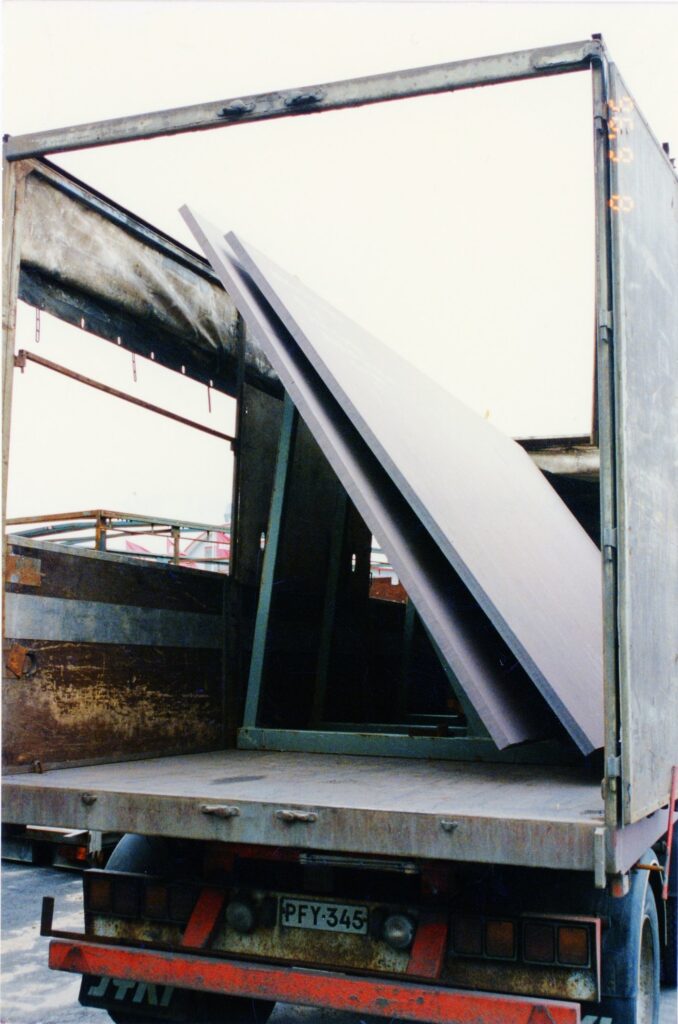
1996: Ahola’s innovative solution for transporting 3.5-metre-wide steel sheets inside the cargo space. This gave the advantage of 50% cheaper ferry costs, as no escort vehicle was needed in Sweden and Norway. Lower emissions, better profitability.
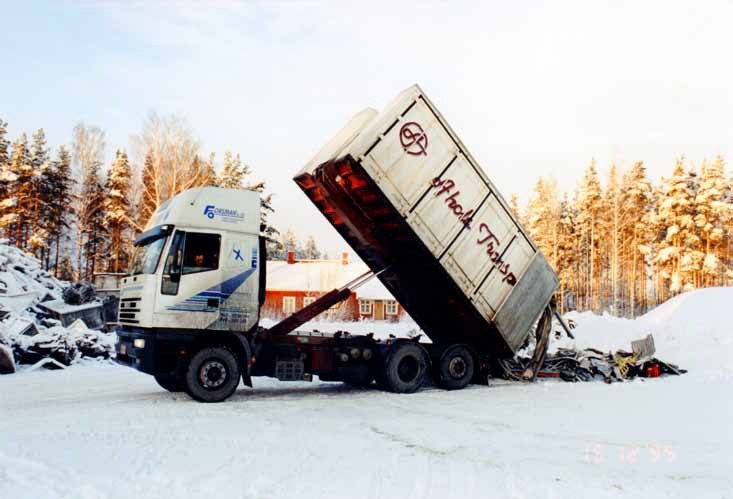
1996: This superstructure was specially designed by Limetec with an openable side and roof. The solution provided great flexibility to load different types of goods, as well as scrap in one direction. Lower emissions, better profitability.
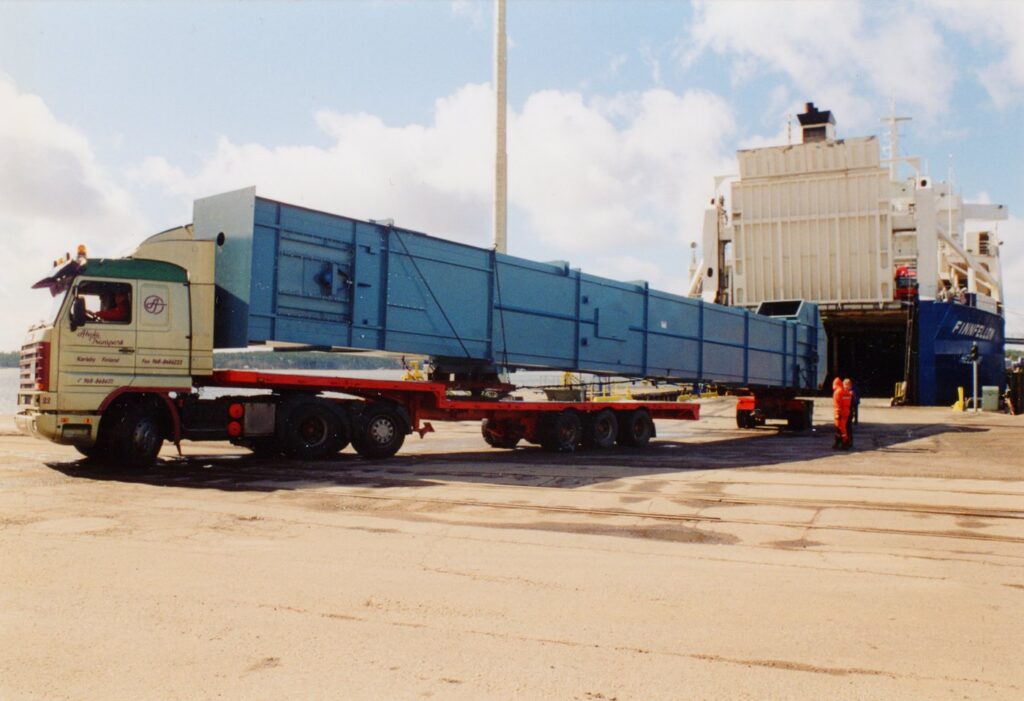
1997: Ahola Transport’s current CEO built a turntable on the trailer where the long goods formed the frame itself, connecting it to the ”nakki” dolly into one functioning unit. ”Lower emissions, better profitability”.
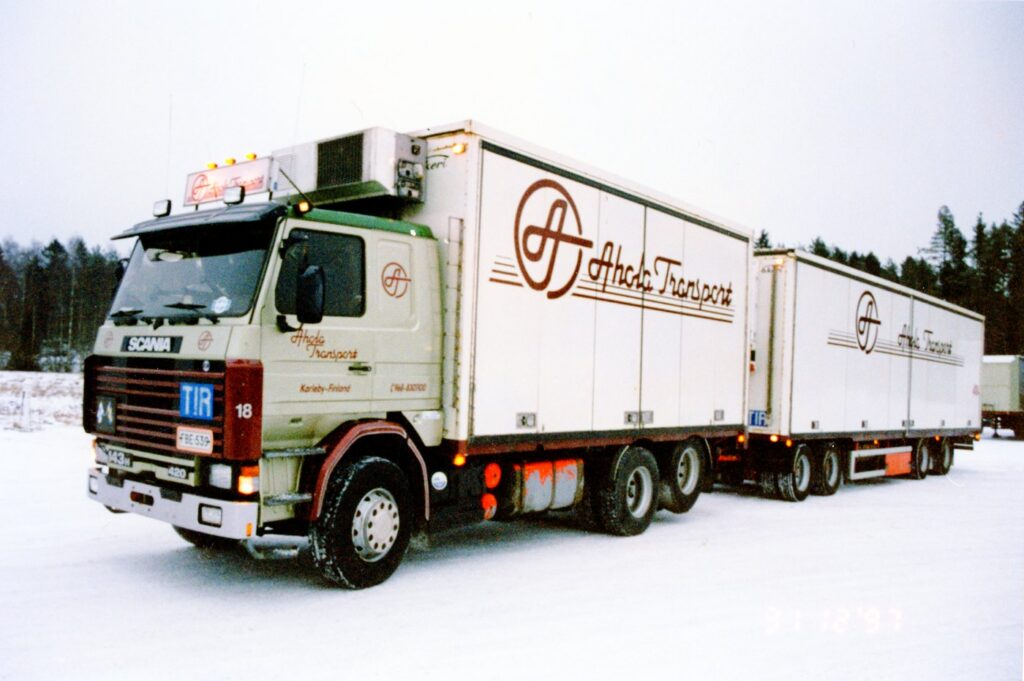
1997: This special combination is also fitted with a Limetec superstructure. The combination enabled steel transports for export as well as temperature-controlled food transports on the return leg from Sweden. The steel could be loaded through the roof thanks to the sliding roof. ”Lower emissions, better profitability”.
Interesting special projects from Sweden to Russia 1995–1997
1996: A turnkey project for Wärtsilä Trollhättan. The project was to transport an entire power plant from Trollhättan to Moscow. The project required over 30 trucks at one and the same time, which called for somewhat extraordinary measures. Our company was not all that big at the time.
Afterwards, I have wondered how we won the trust to carry out this project. My assessment in hindsight is that there were hardly any transport and logistics companies in Sweden with experience of transports to Russia. In Sweden, on the other hand, people felt that the Finns knew how to deal with Russia. I believe we had no competition whatsoever for this project; the Wärtsilä team trusted us completely.
The project was a success for us, and as a result we won several other projects to Russia. Another interesting project went to Tyumen in Russian Siberia.
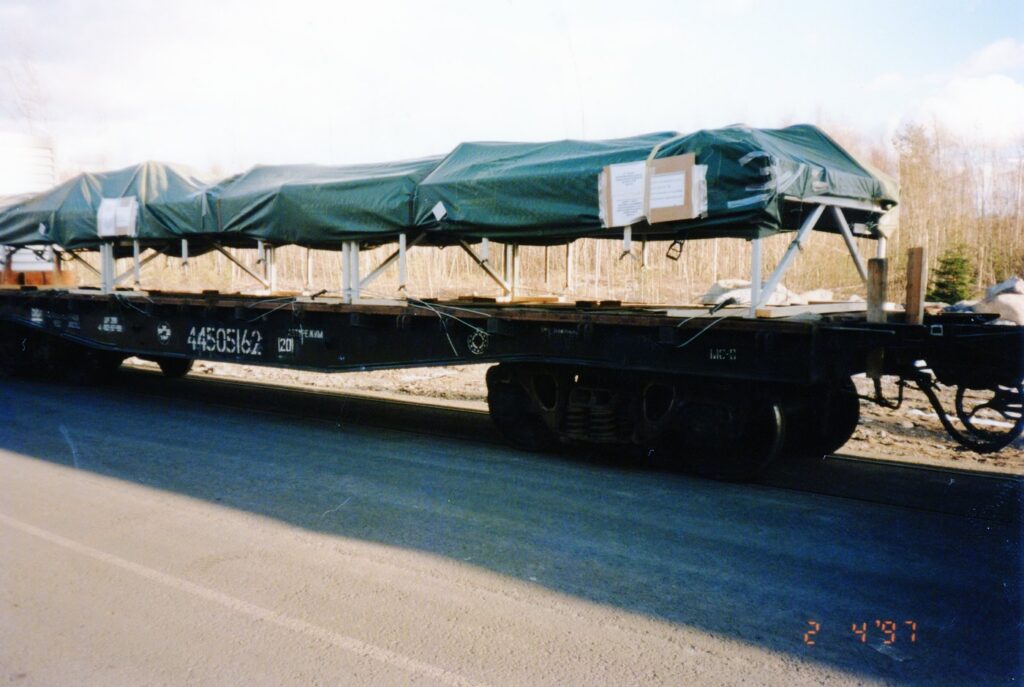
We carried out this project as our first multimodal solution: truck from Trollhättan to Kouvola and transloading to rail for the final leg to Tyumen. Only one transport went directly by truck from Trollhättan to Tyumen. Even then, at the customer’s request, we could offer satellite tracking for this transport. I don’t remember who the rail operator was, but it worked to the satisfaction of both the customer and us. Probably a Russian rail operator.
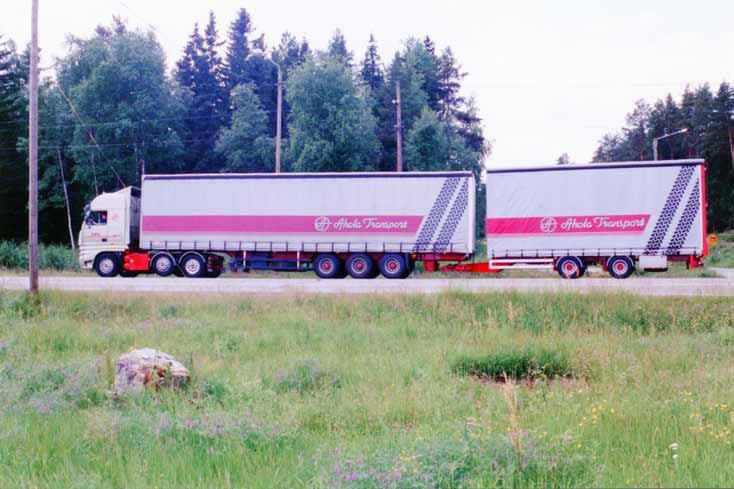
1998: Ahola was the first to use this type of combination in the Sweden traffic. A very efficient solution. ”Lower emissions, better profitability”.
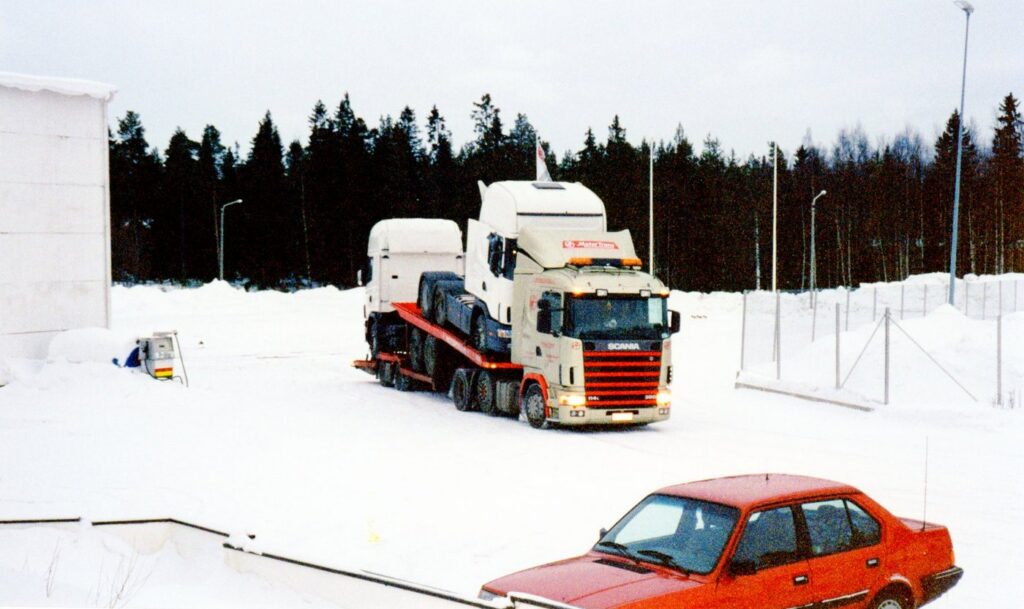
1998: Chassis transports for Scania were started after long negotiations.
”Lower emissions than driving the trucks individually by road!
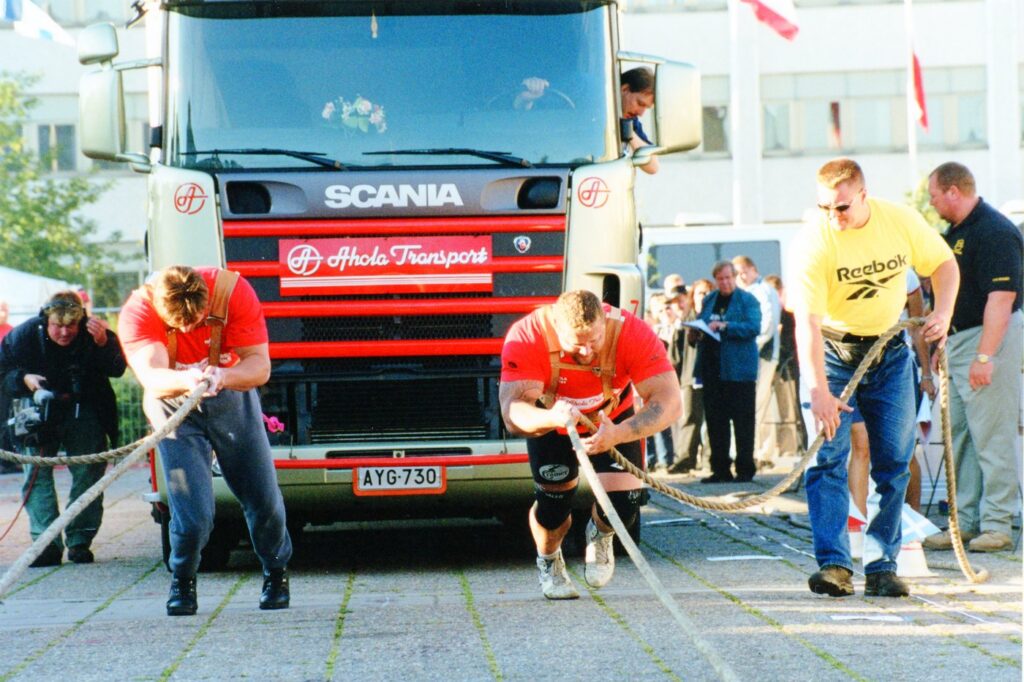
1999: ”Zero emissions” – Jouko Ahola and a few other strong lads.
Heavy eco driving 1997
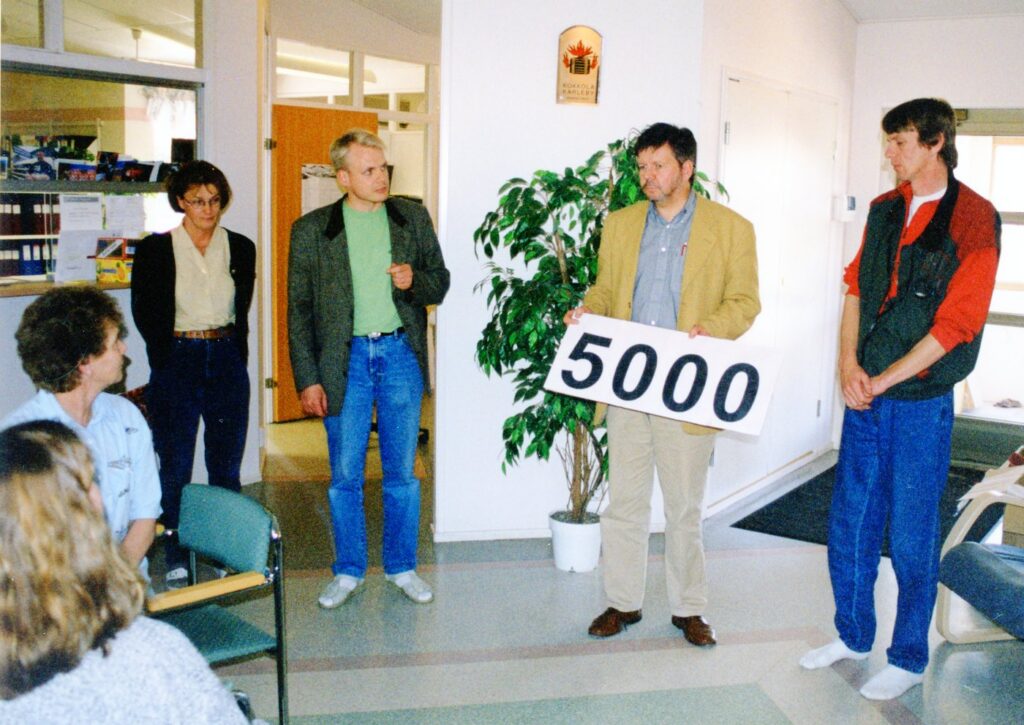
In 1997 Ahola launched fuel-efficient driving competitions for its drivers, which were given the name ”light-foot of the month”. The idea of the competition was that whoever achieved the best improvement compared with their previous result was the winner. The reward was 5,000 markka, and the first winner was Peter Sandbäck.
The fuel transports 1965–1997
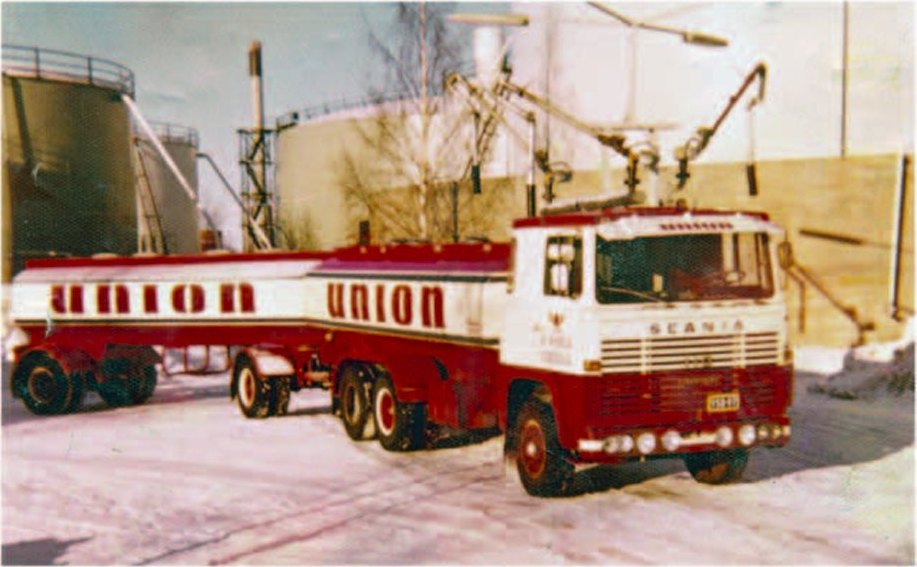
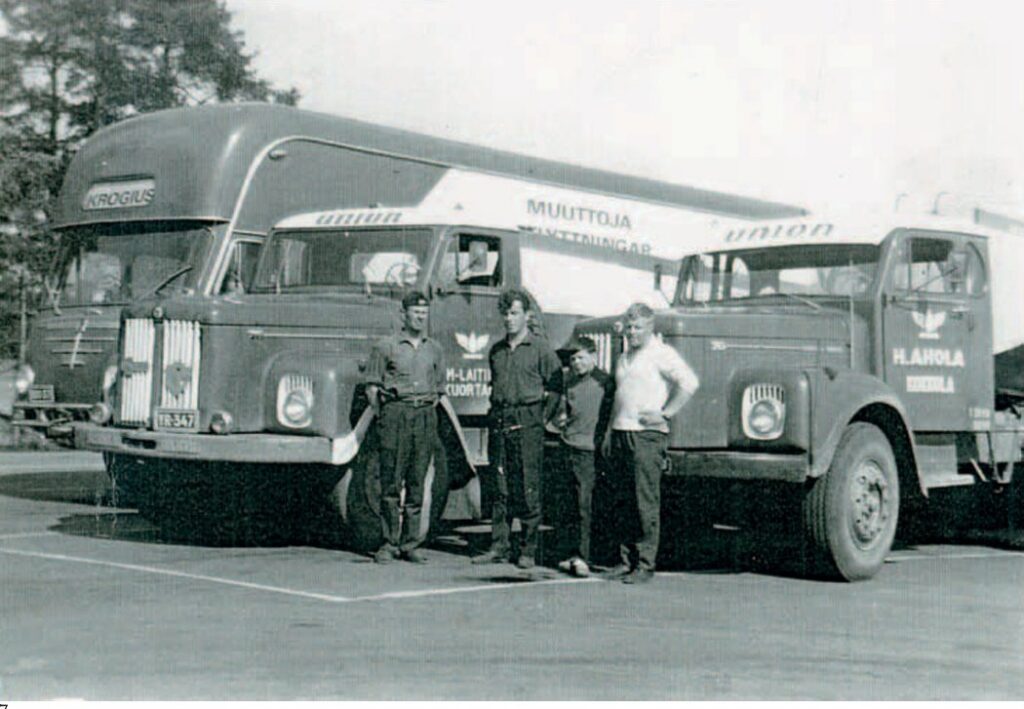
The fuel transports that our father started with Union-Öljyt Ab Oy in 1965 remained part of our operations right up until 1997. Over time, that business became ever smaller in relation to our core operations, which is why we decided to sell it off.
We did so in 1997, when we sold the business to Jari Välikangas Oy in Härmä.
In hindsight, one can wonder how wise that was. It has since turned out that there would have been opportunities to expand in this segment as well.
The last of our own tanker trucks was sold in 1997 to Jari Välikangas Oy in Härmä, and with that the long-standing cooperation between Ahola Transport and Union-Neste came to an end.
The decision to build our own ERP system 1997
1998: Ahola started building its own digital ERP platform to manage our dynamic logistics concept as efficiently as possible. The idea is simple: there are customer needs with their specific requirements, and we have transport resources to carry out these transports as efficiently as possible. ”More goods on fewer trucks” was the starting point. How to achieve this? Every new day we must have a real-time overview of this, the customer needs and the resources. To arrive at the best conceivable solution, we must be able to simulate the best solution using real-time data.
That is why our digital logistics platform ”ATTRACS” was built to meet these requirements.
Attracs was built on six basic principles:
- A global tool that handles languages, currencies and GMT times.
- Independent of cargo type
- Independent of load carrier
- All addresses are linked to coordinates (making it easier to navigate to the right address).
- Granular data, enabling simulation from every perspective (customer, unit, driver, etc.).
- Simulation to always find the best and most efficient solution that also meets the customers’ other requirements.
Right from the start, Rolf Lampa joined us as system architect with responsibility for the whole project. Rolf Lampa is my cousin’s son from Sweden.
It was Rolf who made us aware that emissions measurement and reporting would become important in the future. That is why we decided from the very beginning that our system must be able to share fact-based emissions reports based on the individual shipment. We have been able to do this ever since our ERP system was taken into use in 2003. This is very unique, and we are probably the only company capable of doing it.
From the very beginning, we realised that with this way of thinking and the digital ATTRACS platform, we would be able to measure emissions for each individual shipment. This is possible because we link operational data with vehicle data.
Thanks to our way of working with dynamic and efficient solutions, we have been able to reach the EU’s emissions targets 10 years ahead of schedule. Our actual emissions for 2024 were 27.6 g per tonne-kilometre.
The strong growth of the 1990s
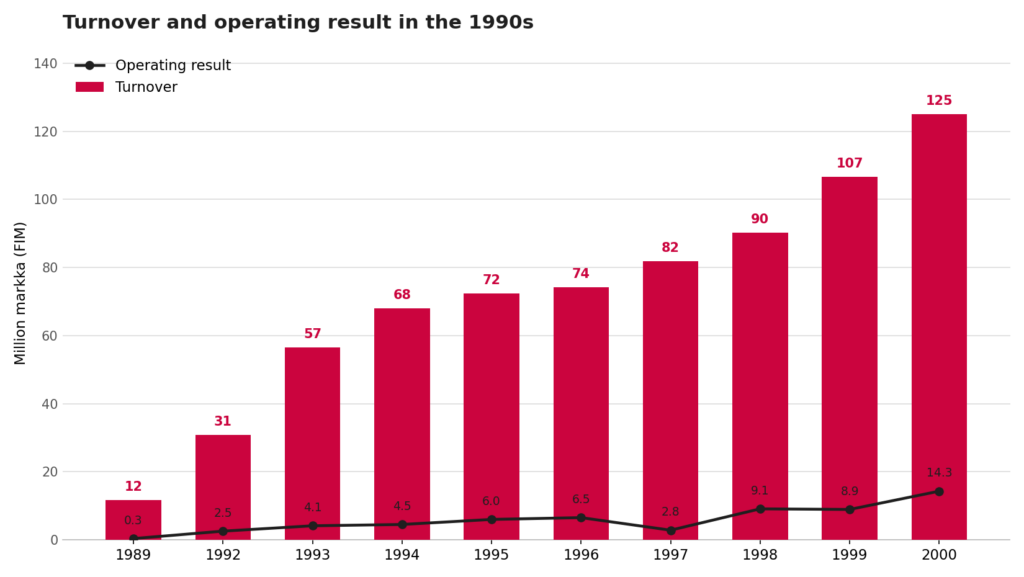
The chart above shows the enormous development we were part of during the 1990s.
Considering the incredibly tough recession, it is quite incomprehensible that we could deliver such growth. Turnover grew tenfold during this period, and profitability was at a very high level. An average EBIT of just over 8% for the whole period is really beyond belief.
I must say that this is not of this world – without God’s guidance it would not have been possible.
I also want to thank all of you employees who worked with us during this period.
I am also very glad that so many of you still work with us today.
To sum it all up, I would highlight a few points.
- When the Soviet Union fell, Finnish export industry was in a hurry to turn to other markets. And thanks to the devaluation, companies became competitive. In tough times, purchase decisions were postponed as long as possible, but once the decision was made, there was a rush.
- When our big competitors in logistics cut back on their sales staff, they struggled to keep up with all the twists and turns. So we introduced a way of working in sales where we responded to every enquiry within one hour. This model was very effective and paid off handsomely. Often, when we called the customers back the next day, the answer was mostly the same: no one else has responded or submitted a bid yet, so the deal is yours. Naturally, we needed more time for major tenders.
- There was quite a strong export–import imbalance, as consumption was low in Finland while exports were doing well. So we invested very heavily in sales in Sweden and Norway, and we succeeded well there too. It is very much about commitment!
That was the interesting story of our development during the 1990s.
Facing the coming new millennium, we felt a slight flutter in our stomachs – after all, it was something very unique and new to look forward to.
Feel free to follow along when, in a while, I publish the next part of my memoirs.
Hans Ahola
Chairman of the Board
Ahola Group